SkeptiCamp 2010 II

On October 23rd, 2010, several dozen skeptics descended on UBC for the second SkeptiCamp of 2010: a full day of science, education, questioning assumptions, and rap. Good times.

On October 23rd, 2010, several dozen skeptics descended on UBC for the second SkeptiCamp of 2010: a full day of science, education, questioning assumptions, and rap. Good times.

The Wisdom of Crowds

Jess Brydle had a jar full of candy corn at the back of the room, and attendants were invited to guess the number, with the closest guess winning a prize (an iPod Touch, I think). Though I tried to estimate the volume of a single piece vs. the volume of the jar, my guess (1050) was way off the actual number (around 770). On the other hand, it was almost bang on the average guess. Go me! Conformity over reality!

Google Maps

Jesse Brydle presented an interesting project: displaying bullshit and woo businesses on Google Maps. As you can see, there are a hell of a lot of them. If you look at the comments, (both on the map and Jesse’s blog post), it looks like it hit a major nerve with some of the local witch doctors—as well it should.

Reason Vancouver

Ian Bushfield presented an idea for a new Vancouver political party: Reason Vancouver. Though I approve of its mission statement of “developing policies based on reason and empiricism,” that still doesn’t tell me what those policies are going to be. Ethics (political or otherwise) is only partly based on reason and empiricism. Besides, I’m not convinced Vancouver needs an explicity secular party, since we all know facts already have a liberal bias. Still, it’ll be interesting to see how this develops.

Hamlet: The Skeptic Prince

Joe Fulgham made a good case for Hamlet being a good proto-skeptic. When the guards tell him they’ve seen a ghost that looks like his dead father, he accepts that ghosts may exist, but grills the guards, asks for details, and withholds belief until he sees the ghost for himself and talks to it. Even then, after he’s told explicit details of his father’s death, he decides to get a second opinion and trick the truth out of Claudius. The theme of Hamlet (as Joe explained, I’m only familiar with the basics) was that giving in to his passions is what destroyed Hamlet. If he had stuck to reason (and yes, skepticism), things might have been different.

I’m not totally convinced of his conclusion that Shakespeare himself was a proto-skeptic, and spoke through his characters, though. C.S. Lewis (just to pick one example) wrote a couple of skeptics in his Space Trilogy, but he himself was far from one.

Baba Brinkman’s Rationalist Rap

Meet Baba Brinkman, “the propaganda wing of skepticism.” He brought the house down with his rationalist anthem, “Off That!” Totally awesome.

I got witnessed to!

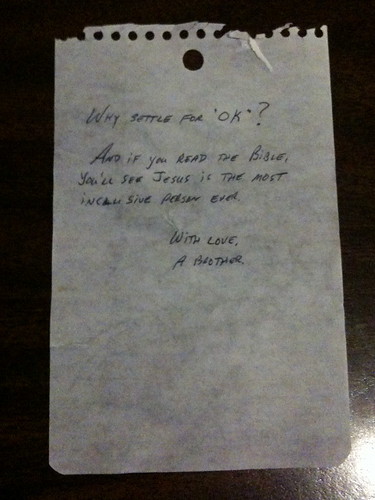
When I got back to my car in the pouring rain, I noticed a little soggy piece of paper stuck in my car’s windshield. For a second I was afraid it was a ticket (though I hear parking tickets at UBC are only a problem for UBC students), but it was something very different:
Why settle for

Why settle for “OK”?

And if you read the Bible, you’ll see Jesus is the most inclusive person ever.

With love,
A brother.

Sigh. Just like that hip-hop drive-by witnesser of years ago, here’s a guy who couldn’t help reacting to my “Born OK The First Time” and “Celebrate Diversity” bumper stickers. I’m slightly impressed that he took the time to write his note in the rain, but very unimpressed at his blinkered world view. Well, I didn’t get angry this time, just shared the note with my atheist friends at the pub afterwards and we all had a good laugh.


How to Identify Pseudoscience, Quackery, and Fraud with Dr. Harriet Hall

Okay, it’s been almost two weeks, and I’ve kept putting off blogging about this event. Partly because I’ve been extremely busy, with a new full-time job and working on my freelance career, and partly because, well, I didn’t learn anything earth-shattering. Dr. Hall’s talk at Langara College about the ins and outs of pseudoscience, what it is, how to identify it, and why people believe in it, covered a lot of ground already well-visited by people like Michael Shermer. Still, there were some good tidbits. In point-form, then:

Okay, it’s been almost two weeks, and I’ve kept putting off blogging about this event. Partly because I’ve been extremely busy, with a new full-time job and working on my freelance career, and partly because, well, I didn’t learn anything earth-shattering. Dr. Hall’s talk at Langara College about the ins and outs of pseudoscience, what it is, how to identify it, and why people believe in it, covered a lot of ground already well-visited by people like Michael Shermer. Still, there were some good tidbits.

“Thinking like a human” is not a logical way to think but it is not a stupid way to think either. You could say that our thinking is intelligently illogical. Millions of years of evolution did not result in humans that think like a computer. It is precisely because we think in an intelligently illogical way that our predecessors were able to survive…
—Morgan Levy, MD

And that quote from Dr. Morgan Levy’s book Placebo Medicine (available free online) pretty much sums up why people believe weird things.

One thing I did learn was that Jesus promoted colon cleansing. No, seriously! It’s in the Essene Gospel of Peace. Good to know whenever the old Argument from Authority is pulled out.

“Think not that it is sufficient that the angel of water embrace you outwards only. I tell you truly, the uncleanness within is greater by much than the uncleanness without. And he who cleanses himself without, but within remains unclean, is like to tombs that outwards are painted fair, but are within full of all manner of horrible uncleannesses and abominations. So I tell you truly, suffer the angel of water to baptize you also within, that you may become free from all your past sins, and that within likewise you may become as pure as the river’s foam sporting in the sunlight.

“Seek, therefore, a large trailing gourd, having a stalk the length of a man; take out its inwards and fill it with water from the river which the sun has warmed. Hang it upon the branch of a tree, and kneel upon the ground before the angel of water, and suffer the end of the stalk of the trailing gourd to enter your hinder parts, that the water may flow through all your bowels. Afterwards rest kneeling on the ground before the angel of water and pray to the living God that he will forgive you all your past sins, and pray the angel of water that he will free your body from every uncleanness and disease. Then let the water run out from your body, that it may carry away from within it all the unclean and evil-smelling things of Satan. And you shall see with your eyes and smell with your nose all the abominations, and uncleannesses which defiled the temple of your body; even all the sins which abode in your body, tormenting you with all manner of pains. I tell you truly, baptism with water frees you from all of these. Renew your baptizing with water on every day of your fast, till the day when you see that the water which flows out of you is as pure as the river’s foam. Then betake your body to the coursing river, and there in the arms of the angel of water render thanks to the living God that he has freed you from your sins. And this holy baptizing by the angel of water is: Rebirth unto the new life. For your eyes shall henceforth see, and your ears shall hear. Sin no more, therefore, after your baptism, that the angels of air and of water may eternally abide in you and serve you evermore.

Dr. Hall also quoted from Pope Brock’s Charlatan, a book about old-time huckster Charles Brinkley, who got famous by performing goat-to-human testicle transplants, to restore the energy and virility of his patients. It sounds deliciously weird, and I’ve added it to my reading list.

She concluded with a few tips on how to deal with pseudoscientific claims or theories:

  • How do I know that’s so?
  • Where’s the evidence?
  • What’s the evidence against? Is there another side to the story?

Which leads to the SkepDoc’s rule of thumb:

Before accepting a claim we should try to find out who disagrees with it and why.

Words to live by.

A whole lotta sunsets

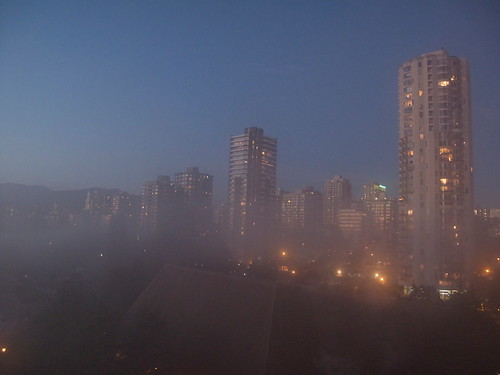
Well, just two for now. This week I started working full-time again— a short contract, which suits me right now. But it gave me the chance to take some lovely shots of the commute to and from North Van. Plus, just tonight, as I came home I saw False Creek swathed in a lovely fog, so I got right on Burrard Bridge to take a few shots. Turns out I wasn’t the only one, seems like every photographer in the area had the same idea!

Well, just two for now. This week I started working full-time again— a short contract, which suits me right now. But it gave me the chance to take some lovely shots of the commute to and from North Van. Plus, just tonight, as I came home I saw False Creek swathed in a lovely fog, so I got right on Burrard Bridge to take a few shots. Turns out I wasn’t the only one, seems like every photographer in the area had the same idea!

Sunrise from Lions' Gate Bridge

Lions' Gate Bridge

Skyline and Sunset

Canada Place

Vanier Park

The West End

Vancouver International Film Festival Review: The 4th Revolution: Energy Autonomy

The 4th Revolution is a showcase of the future: the technologies, the vision, and the visionaries that will take us away from a reliance on fossil fuels, and towards clean renewable energy for everyone.

Guess I should finally blog about the last movie I saw in the VIFF, and by far the most uplifting.

The 4th Revolution is a showcase of the future: the technologies, the vision, and the visionaries that will take us away from a reliance on fossil fuels, and towards clean renewable energy for everyone.

It’s possible. There are so many bright, dedicated people all over the world, from Germany to China to Mali to Bangladesh, working tirelessly in ways big or small to change lives or change minds: designers making electric cars look sexy, neighbours cooperating to upgrade an apartment building with solar generators, the economist who pioneered microlending, the people installing small solar panels in rural Africa.

Energy autonomy is more than just saving a few bucks on your electric bill. First, it’s about saving a lot of bucks on the electric bill. Solar panels on individual buildings or houses, combined with other upgrades to cut down on, e.g., unnecessary air conditioning, can cut external power consumption drastically. But it also means economic autonomy. The Mali Folke Centre is a case in point: by promoting the use of solar energy in regions where electricity is extremely rare and expensive, they allow people to regularly work after dark. Not a big deal? But as programme coordinator Ibrahim Togola explains, it opens the door for people to create new enterprises, and move Mali away from a purely resource-exporting base for its economy.

The stakes are enormous, and so are the obstacles: lack of political will in many countries, not least being the USA; entrenched interests in the coal/gas/oil industry, and the simple fact that reworking out energy infrastructure will be a difficult process. But the general consensus is that the transition is indeed possible, and so the movie ends with a positive note.

Vancouver International Film Festival Review: Insomnia

More Canadian shorts, but these are more focused on art and the artist’s life.

More Canadian shorts, but these are more focused on art and the artist’s life.

L’année de l’os

Some weird abstract shit. Pretty entertaining under different circumstances, but it was also fairly hypnotic and I think it put me to sleep. Not kidding, but I also blame the fact that I was tired that day.

The Sapporo Project

A lovely animated short featuring the work of Japanese artist and calligrapher Gazanbou Higuchi.

Lippset Diaries

An imaginary peek inside the tortured mind of experimental filmmaker Arthur Lippset

Madame Perrault’s Bluebeard

A disturbing retelling of the story of Bluebeard, where fiction and reality merge.

Figs in Motion

Two butch daddies put on tutus and prance about. Then they put on horse heads and keep going. Very, very cute.

Ghost Noise

The longest film of the series, this is a look at Inuit artist Shuvinai Ashoona, her life in Cape Dorset, and the strange, wonderful things going through her mind.

Flawed

A long-distance relationship between an artist and a successful plastic surgeon, narrated by the artist herself and illustrated with hand-painted postcards. The resolution definitely counts as a Crowning Moment of Heartwarming

Break a Leg

An aspiring actor rehearses a scene with his grandson in a diner. Better than it sounds.

Labour Laws

Anything a woman can do, she can do pregnant! Wait, even pole dancing? Sure! Why not?

Exposed

An elevator breakdown leads to a moment of passion between a photographer and his surprise subject. Hilarious and erotic.

Ladies and Gentlemen: Biddie Schitzerman

An eightysomething standup comedienne’s last show with her loyal sidekick. Or is it? CMoH #2 of the night.

Vancouver International Film Festival Review: Amnesia

Some fine, fine Canadiana on display in this collection of short films! Touching, funny, or just creepy, but most of all, very bilingual! I’m not exactly sure what amnesia has to do with Canada, and I didn’t see any particular theme amongst the films… But anyway, on to the reviews!

Some fine, fine Canadiana on display in this collection of short films! Touching, funny, or just creepy, but most of all, very bilingual! I’m not exactly sure what amnesia has to do with Canada, and I didn’t see any particular theme amongst the films… But anyway, on to the reviews!

Moi non plus (Me Neither)

The first, and weakest, short. A Concordia (I think) student must deal with a relationship with a powerful politician, who seems to be tangled in shady businesses, and a surprise affair with a charming fellow student. Unfortunately the characters weren’t really developed, and the ending was anticlimactic and predictable.

Mind the Gap

But now we’re picking up steam! This hilarious little film pairs up a beautiful but seriously messed up young woman with a sweet older gentleman. Stuck together on a train, she talks his head off about whatever flashes through her tiny brain. We laugh, we cringe, we want to slap some sense into her. Good times.

Naissances

A teenager who just had an abortion and a lonely handyman bond over lies. Quiet, sad and beautifully done.

Transmission

A tow truck driver just struggling to get by finds his day getting worse and worse. A simple slice of life, with disturbingly believable characters.

La dernière rondelle (The Last Time Around)

An old hockey player suffering from Alzheimer’s goes on the ice one last time. Wordless, and deeply moving.

Au milieu de nulle part ailleurs (Nowhere, Elsewhere)

A little boy who can see the Virgin Mary, a grandmother who might see ghosts, and a mother who thinks she might join them. Weird, crazy, dizzying, creepy.

Original Sin

Choices, order, and control freakery. Weird but hilarious.

Chloe and Attie

An old lady who can… make people kill each other through their iPods? I don’t know what that was about, but it was pretty damn chilling.

A Fine Young Man

A hilarious parody of Cold War paranoia and jingoism (filmed on location in Vancouver! Didn’t recognise the street, though…) What’s more important that beating those dirty Commies to the Moon? The answer may surprise you…

The Closer You Get to Canada

And the black humour continues! In the year 2060, overpopulation is no longer a problem. Running out of animals to hunt used to be a problem, but not anymore…

Vancouver International Film Festival Review: Palimpsest

Gustav Shpet: Russian philosopher, teacher, writer, polyglot and interpreter; born in Kiev in 1879; exiled to Tomsk, Siberia in 1935; executed in 1937.

This movie is mostly narrated by Shpet’s 92-year old daughter Marina in a series of informal interviews, intercut with contemporaneous film reels, photos and music, as well as Shpet’s letters to Marina during his exile.

Gustav Shpet: Russian philosopher, teacher, writer, polyglot and interpreter; born in Kiev in 1879; exiled to Tomsk, Siberia in 1935; executed in 1937.

This movie is mostly narrated by Shpet’s 92-year old daughter Marina in a series of informal interviews, intercut with contemporaneous film reels, photos and music, as well as Shpet’s letters to Marina during his exile.

We follow Marina as she visits the university (much changed) where her father taught, the church she occasionally attended in the 30’s (hardly changed); tries to visit the apartment where she lived (security wouldn’t even let the film crew and her through the front door); tells the story of her husband, who died one year after her father, working to take down the Russian coat of arms from the Kremlin’s Spasskaya tower and replace it with the tacky red neon star that still shines today.

And we visit a Tomsk museum to Siberian exiles. Shpet is just one of hundreds of names that came to Siberia, one face on a whole wall of faces. The museum curator tells visitors that the NKVD actually planned their purges and ethnic cleanses, with expected minimums (quotas?) of roundups for each region per year.

In the end this is not a story about one man, smart and accomplished though he was. It’s a story about memory, connecting with our past the better to understand our present. And it’s about a past that’s always present no matter how much we try to erase it—streets and buildings, phrases, memories. The Soviet regime did their best to erase ideas, thoughts, and people. To a degree they succeeded, but only to a degree. Shpet told his daughter that “culture, culture, not politics” is what will keep us moving forward. Without going into too much detail, I tend to agree. Culture, memory both individual and collective, this is vitally important to identity and progress.

Palimpsest was preceded by the short Heart in the Wrong Place (original title: Tener el corazón en el lugar equivicado), featuring the extremely awesome experimental filmmaker José Antionio Sistiaga.

Vancouver International Film Festival Review: The Eye 3D

This hour-long film takes us on a tour of the Very Large Telescope array in Cerro Paranal, Chile—the most powerful deep-space telescope in the world. We hear the scientists and technicians describe their work and discoveries, and through them get a tantalising glimpse of the cosmos.

This hour-long film takes us on a tour of the Very Large Telescope array in Cerro Paranal, Chile—the most powerful deep-space telescope in the world. We hear the scientists and technicians describe their work and discoveries, and through them get a tantalising glimpse of the cosmos.

I expected to see lots of grand starscapes, as in that IMAX movie on Hubble, but we only see a little bit of those right at the beginning, to get us in the mood. The rest of the movie is very down to earth, a lot of it dealing with life at a compound in the middle of nowhere, and the nitty-gritty details of scientific research and making those ginormous telescopes work. And you know what? This was just as inspirational. The people there absolutely love their work: the phrase “dream come true” comes up at least twice from resident scientists; one relatively minor technician also waxes rhapsodic about the VLT’s work in pushing back the boundaries of knowledge, and awesomely refers to the community of workers as his second family.

But we also hear about the science, and it is beautiful: from the supermassive black hole at the core of our galaxy (indirectly detected from tracking the movements of nearby stars, themselves detectable only by the VLT), to another scientist’s research into extragalactic black holes and how our own black hole applies to that, to monitoring the ancient light of unbelievably faraway galaxies… Man, working there really would be any astronomy geek’s dream come true.

The ESO is planning an even larger telescope array, called the Extremely Large Telescope. The location still hasn’t been decided as far as I know, but one candidate site is not too far from the Cerro Paranal—it’s really an ideal region, high up and very dry all year round. Even now the next generation of astronomers, in high school or university, are dreaming and working and a select few will get to work on the ELT, looking for Earth-like planets around distant stars and studying light remnants from the first generation of galaxies.

PS: The movie was in 3D, which I found pretty unnecessary. I’m no fan of 3D to begin with, and with most of the scenes being talking heads, or indoors, I really didn’t see why I had to wear an extra pair of glasses. Meh. Still, that was the only sore point.

High School Confidential

The Out on Screen Society does a lot more than put out quality queer cinema. They also run Out in Schools, a program to put queer films in schools all across the province, to facilitate discussion and fight homophobia and bullying. The news have been full of stories of gay teens committing suicide due to bullying—and don’t think it doesn’t happen in Canada. That’s why Out in Schools is such a vital program, because it may be the difference between life and death for some students.

The Out on Screen Society does a lot more than put out quality queer cinema. They also run Out in Schools, a program to put queer films in schools all across the province, to facilitate discussion and fight homophobia and bullying. The news have been full of stories of gay teens committing suicide due to bullying—and don’t think it doesn’t happen in Canada. That’s why Out in Schools is such a vital program, because it may be the difference between life and death for some students. Reminding them that It Gets Better may help also.

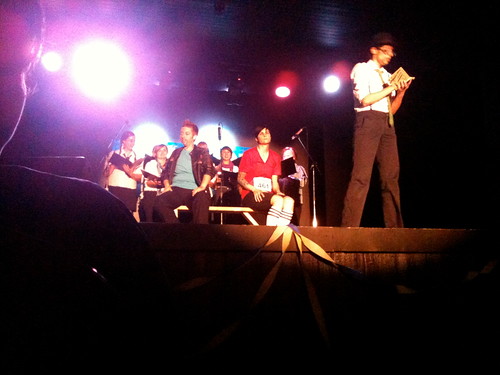
But in spite of the seriousness, there was a lot of fun to be had. Yummy baked goods, a stint in detention where you might have to do lines or get spanked by a nun, dressing up as a nerd or jock, it all adds up to a freaky fetishy fantasy of a high school that never was, where queer is either just another word or the word of the day. And it was awesome. Looking back I probably should have dressed up, if only putting tape on the bridge of my glasses or something, but oh well.

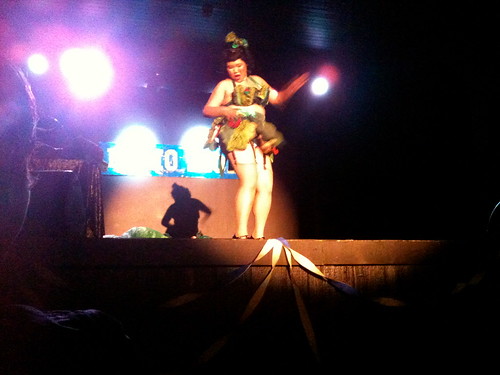
And then you had the cabaret acts. Because these days you can’t put “high school” and “queer” together without it adding up to “Glee,” the first act was a chorus doing “Don’t Stop Believing”. Then you had the usual gamut: a couple drag acts, a truly awesome gardening-themed stripper, a nerdy librarian who tries to keep it classy but can’t help stripping, and a poetry reading. Great fun.

Apologies for the low quality, all I had was my iPhone and the light level wasn’t too good.

Don't Stop Believing!

Joanie Gyoza

Raye Sunshine

Skeptivism: Van Praagh at the River Rock Casino

Last Saturday a handful of skeptics from CFI Vancouver went down to the River Rock Casino to protest their showcasing James Van Praagh, one of the big-name cold-reading vultures preying on people’s fears and grief, by pretending to hear from dead people.

Last Saturday a handful of skeptics from CFI Vancouver went down to the River Rock Casino to protest their showcasing James Van Praagh, one of the big-name cold-reading vultures preying on people’s fears and grief, by pretending to hear from dead people.

Stars

And by “protest,” I mean that just as with Deepak Chopra in June and John Edwards in August, we politely handed out flyers to Van Praagh fans on their way to the show. Just a friendly smile, a “are you here to see Van Praagh? Here’s something to read while you’re in line!” capped off by a “Enjoy the show!” Some frowned, some gave the pamphlets back, one young woman told us she believed in psychics because she was psychic. We never did find out exactly what she believed about her psychicness, so we just parted on a note of “we all have our opinions and we’ll agree to disagree.” Because what else can you do? We weren’t here to make a scene.

But even so, security eventually asked us to leave. Fair enough, we were on private property, and the casino was completely within its rights to kick us out if we were bothering its customers. Most of us retreated to the Skytrain, while the two women in the gang continued to hand out pamphlets on the sidewalk in front of the casino. The guys debated joining them, but (a) I for one was kinda nervous about casino security keeping an eye on us, and I didn’t want to be arrested, however small the probability, and (b) the women seemed to be doing okay, and were probably less likely to be hassled by security, since they looked less threatening.

It was an interesting experience. Kind of anticlimactic, which I guess is a good thing. Doubly good because unlike the Edwards outing, we didn’t have to face any grieving people clinging to false hope. Yeah, i don’t think I could have handled that. Plus, I’m not too diplomatic even at the best of times, and I can’t think of a nice way to tell vulnerable people they’re being strung along by a con man.

So in the end, what did we accomplish? I don’t know. Some people read the pamphlets, sure, and that’s important. Planting seeds of doubt is never a bad thing, but there’s got to be a more efficient—not to mention legal—way to go about it. I think the saying “You don’t pray in my classroom and I won’t think in your church” applies here. As revolting as I find Van Praagh and his cohorts, the casino’s running a business and we can’t expect them to give us free access to their chumpscustomers.

What’s the solution? Obviously there’s no magic bullet to remove gullibility and ignorance, and some people will hang on to their beliefs in spite of all the evidence in the world. Skeptics just have to keep trying. This kind of skeptivism, Getting into people’s faces, does have a place, though we need to go at it a little more smartly, and there are other things CFI should do. Reach out to schools, get kids while they’re young! We’re talking about all those things and more. Stay tuned