Two things you only see at night

Last night was the first installment of the Celebration of Light. I was exhausted from work and volleyball, possibly coming down with something, and I actually considered not going. But hey: I’m right next to the beach, it was Canada Night, and I’d get to see how this new camera of mine handled fireworks.

Verdict: awesome.

Last night was the first installment of the Celebration of Light. I was exhausted from work and volleyball, possibly coming down with something, and I actually considered not going. But hey: I’m right next to the beach, it was Canada Night, and I’d get to see how this new camera of mine handled fireworks.

Verdict: awesome.

Fireworks, July 22

And then today, I took pictures of a bat at work. Just a little bat, hanging on to the wall of the inner courtyard, and sleeping. That’s the first time anybody’s seen it there, at least in the daytime. I wonder if it’s lost, or disoriented? A coworker said it might have gotten drunk on rotten apples and was sleeping off its hangover.

Bat

I wish I could have gotten a look at its face. As it was, I had to settle for its wee little claws (on its feet, and the single claw on its wing-joint) that seem enough to support its weight, the soft little fur on its back, and daintily folded wings. Also, since I was shooting through a window, I got to practice with my camera’s manual focus.

Relics

Quebec (the province and the city) has a lot of history. In Vancouver, “old” just means turn of the century (Gastown, some of Strathcona and New Westminster). But Vieux-Québec? Try turn of the eighteenth century, then we’ll talk. Everything just feels old, every street corner has a hundred stories to tell.
Quebec (the province and the city) has a lot of history. In Vancouver, “old” just means turn of the century (Gastown, some of Strathcona and New Westminster). But Vieux-Québec? Try turn of the eighteenth century, then we’ll talk. Everything just feels old, every street corner has a hundred stories to tell.

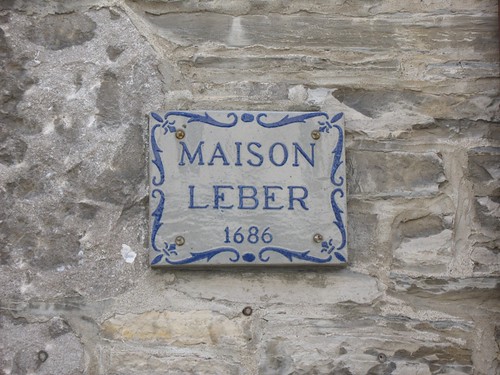
Maison Leber, 1686

Most of that history is Catholic. Half the streets are named after saints, many of the historical buildings are churches, convents, presbyteries and so on. Every aspect of French-Canadian history is soaked in religious tradition. I don’t especially mind, when I see it purely as history. As much as I despise organised religion in general, and the Catholic Church in particular, it has inspired some beautiful art and architecture.

Mind you, Quebec’s not as religious as it used to be. A lot of these traditions are dying off, and so are the communities. Just as an example, Île-d’Orléans used to contain six parishes, one for each village, each with its own church and presbytery (where the religious folks lived). And maybe school, too, although I’m not sure about that. About twenty years ago, those six parishes were merged into two. Nowadays, there’s only one priest to serve the entire island, assisted by one other priest from the mainland to hold services at all the churches on the weekend. Which, let’s face it, is not a big trek, but still. It’s a hell of a change in just a couple of generations.

Many cash-strapped religious orders have also sold off buildings and property, which have been converted to other uses. Just as a for instance, the former presbytery of Sainte-Famille, Île-d’Orléans, is now a genealogy museum. Not to mention that Anglican church in Strathcona, converted to an art studio. A big improvement in both cases, I think.
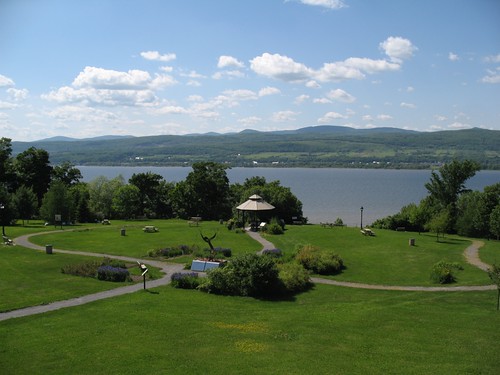
Genealogy Museum

We had dinner with a family friend, a parish priest in downtown Quebec who used to be assigned to our parish in Ottawa. He had some fun stories about the Dominican order’s internal politics, at the local and provincial level. But also stories of shrinking, and aging, flocks as well as priest communities themselves. Part of me felt a little sad for him. It can’t be easy to see your community and your whole way of life implode like that in his lifetime. As much as I believe the world is better off with less oppressive tradition, dogma and blind faith, it’s nothing personal. This friend of ours, he’s good people, and though I don’t respect his beliefs I respect the fact that they’re important to him.

One of the upsides is that nowadays, and especially for children, religious differences are not such a big deal anymore. As the bonds of faith are breaking down, so have the walls between faiths. We visited an Anglican church in Vieux-Québec: Holy Trinity Cathedral (the first Anglican cathedral built outside the British Isles, dating from 1804). There happened to be a gaggle of schoolkids on a field trip, and a guide (or the teacher, maybe) was explaining to these presumably Catholic children some differences between Catholicism and Anglicanism. For one thing, Anglicans display the Ten Commandments in the church. For another, they arrange them a little differently.

Holy Trinity Altar

I’ve got a hard time imagining many pre-Vatican II Catholics willingly setting foot inside a hell-bound Protestant church, let alone having their children be educated on the finer points of Anglican worship and maybe learn that—gasp!—they really aren’t so different after all. Plus, Holy Trinity is supposed to be haunted. Those kids will go home thinking Anglicans churches are wicked cool.

But never fear, true believers. They say the heart of hardcore Catholicism is still beating, and from what I’ve seen I believe ’em.
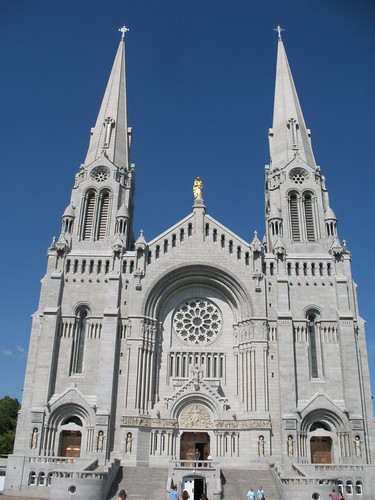
Sainte-Anne-de-Beaupré

Sainte-Anne-de-Beaupré, a little ways from Quebec City, has been a major pilgrimage site for over 300 years. The faithful—who these days are more likely to come in coach buses than on foot—can enjoy the Jerusalem Cyclorama (IIRC, a big diorama of the Passion, with some multimedia thrown in), visit the Museum to Sainte-Anne (gawd knows what’s there, the woman only appears in apocryphal tales and Catholic tradition), browse the gift shop for that perfect tacky plaster Virgin Mary or whatever, and even get their swag blessed by a priest.

No, I’m not kidding. A priest was actually sitting in a little glass-enclosed booth near the gift shop, in full priestly gear, waiting to bless things (for a modest donation, I’ll bet). I just hope that booth was air-conditioned, because it was really hot, and those clothes looked heavy.

First Station

But then you’ve got all the really traditional stuff: the Stations of the Cross behind the church, as well as a couple of small shrines whose purpose wasn’t too clear to me. And the church itself, a huge newly-renovated monster of a cathedral hiding, amongst the pretty architecture and frankly fascinating artwork, some pretty creepy shit.

Fishermen

Exhibit A: genuine holy relic of Sainte-Anne. Yeah. Never seen a relic before, and frankly I could have gone longer without seeing one. It’s a fucking arm, people! Who goes around putting parts of dead people literally on a pedestal? And who accepts on faith that these bits, the earliest dating back to 1670, are really from a woman who was said to exist 2,000 years ago?

Relic

Exhibit B: Sainte-Anne-de-Beaupré, as you may or may not be aware, is reputed to be a site of healing and other miracles. The front pillars of the main church are covered with dozens of crutches presumably left there by people who were healed. Not everybody was so lucky, though. We visited a smaller chapel in the basement, housing another tiny little shrine to Sainte-Anne. Most disturbingly, this one had a couple of photos of children propped up against the statue, and a few folded pieces of paper wedged under the statue’s base. Not hard to guess what that’s about.

I’ll never know how those kids are doing, or if those parents’ prayers were answered. I hope they’re doing better than these other pilgrims from a hundred years ago.

I’ll tell you this, though: at least Catholic faith healing is dressed up with nicer ritual than modern televangelists. Maybe that’s just me, though.

If I had to pick one word to sum up Sainte-Anne, it would be: horrifying. The whole complex, basilica and sideshows, is a monument to blind faith, superstition, and the fleecing of the sheep. It is a scary, scary look at old-school Catholic belief and I for one am so very glad I’m living in a time when the Church’s power is shrinking.


A Mari Usque Ad Mare

A week ago I came back from a trip back east to visit family. It was tons of fun—flitting back and forth between Ottawa, Montreal and Quebec City—and I got to see some relatives I hadn’t seen in years. Plus, I hadn’t been back east in the summertime in ages. As much as I enjoy a white Christmas, going outside without freezing my tail off is nice too.

Our mountains are very pointy
Our prairies are not
The rest is kinda bumpy
But man do we have a lot!

—The Arrogant Worms, Canada’s Really Big

A week ago I came back from a trip back east to visit family. It was tons of fun—flitting back and forth between Ottawa, Montreal and Quebec City—and I got to see some relatives I hadn’t seen in years. Plus, I hadn’t been back east in the summertime in ages. As much as I enjoy a white Christmas, going outside without freezing my tail off is nice too.

Taking Off

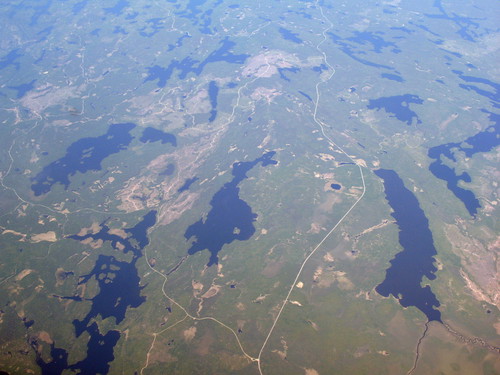
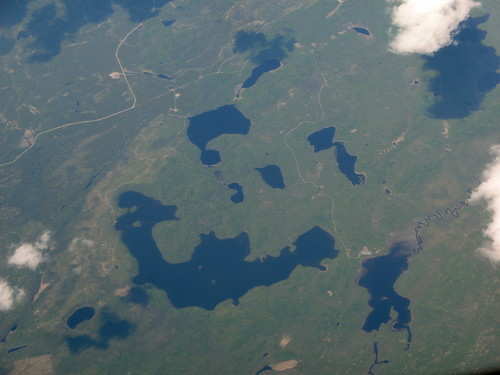
The best part about my flight? I had a window seat, and since the weather was excellent for the most part I got to take pictures of this fair land of mine, from the Rockies all the way to Toronto. After that the weather got too bad, with too much turbulence. And I’ve got to admit: it’s not nearly as boring as I used to think. Sure, the Prairies are flat as anything, but they contain some interesting lakes, rivers and towns. Towns I’d never heard of and probably will never visit, but that’s what makes them interesting. Manitoba and Western Ontario, for their part, are a chaotic maze of lakes and rivers that, well, got a bit boring after a while though I never stopped taking pictures.

Some lakes in northwestern Ontario

I felt like I was exploring Canada with Google Earth, except I couldn’t control where I was going. On the bright side, there was no server lag and the landscape was clear as a bell. The real fun came later, when I looked up my photos on Google Maps. Let me tell you, you haven’t lived until you spent hours desperately hunting for weird lake formations in western Ontario.

OHHH YEAHHH

Doing the tourist thing in Quebec City was awesome. I hadn’t been there since that trip I took shortly after coming out almost seventeen years ago (gawd, time flies), and I’d forgotten how beautiful the city was, from the ancient stone buildings of Vieux-Québec to the bucolic Île-d’Orléans… and Sainte-Anne-de-Beaupré. Which will be the subject of another blog post soon.

Meantime, enjoy some more photos!

Jogging on the Seawall

For the last week, I’ve been taking advantage of the nice weather to get some more exercise done. On Tuesday I decided to get off the SkyTrain at Science World station and use my own two feet to get the rest of the way home. I’d done that just once before, taking a direct route through Yaletown.

Wow. This is what Bike To Work Week must feel like.

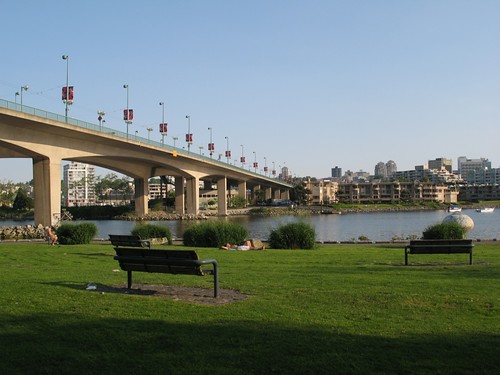
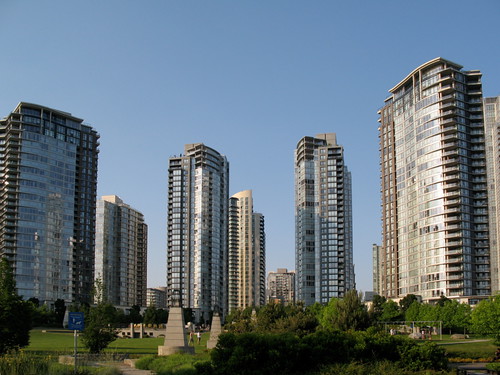
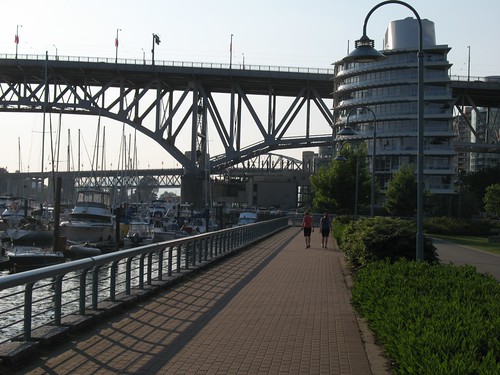
For the last week, I’ve been taking advantage of the nice weather to get some more exercise done. On Tuesday I decided to get off the SkyTrain at Science World station and use my own two feet to get the rest of the way home. I’d done that just once before, taking a direct route through Yaletown. This time I stayed on the Seawall, taking in the nice view of False Creek, the bridges, the parks, and all the pretty yuppies out for their daily constitutional.

Cambie Street Bridge

For extra fun, I also decided to jog as much as I could. I’d been getting in some cardio on the Burrard Bridge stairs a couple of times a week for the last few weeks, but this was a bit more of a challenge.

Yaletown Condos

Then I did it again on Wednesday. And Thursday. And Friday. Hell, I may do it every day as long as the weather holds. As exhausting and sweaty as this was, I had a hell of a time. And hey, it’s never too late to get that bikini body, right?

This actually works out better for me because whenever I get home, I tend to laze around for a bit and have to psych myself to work out sometimes. This way, it’s easier. I’ve got no choice but to go home.

Granville Street Bridge

Chaos and Numbers

I finally have the bones of my new design. It’ll be a 3-column layout, 960px wide. Spent so much time fiddling with the widths, and then it hit me: all I had to do was take a clue from the 960 grid system and let column widths be fractions of the total width. Easy-peasy.

I finally have the bones of my new design. It’ll be a 3-column layout, 960px wide. Spent so much time fiddling with the widths, and then it hit me: all I had to do was take a clue from the 960 grid system and let column widths be fractions of the total width. Easy-peasy. After a bit of experimentation I settled on a 5-column grid, with the left and right sidebar each taking up one column, and the main content section taking up three. The main page will be built on a four-column layout, and will feature a bit more than just a list of recent posts.

And you know, there’s something deeply There’s something deeply satisfying about these proportions. Something clean and orderly. Ancient Greeks (as I understand it) dabbled in numerology, getting all mystical about numbers like the Golden Ratio even as they practised solid mathematics. I can understand that a little better now.

Now comes the hard part: fleshing it all out. But I’m working on that.

In other news, the Team Vancouver is coming along. I had some good breakthroughs in the last week, but I’m one step behind my own site. Instead of seeing everything coming together, I’m at the stage of breaking everything down, trying to forget the present design. It’s all right, though, that’s another kind of satisfaction, to ignore what is, and start seeing the possibilities…

Out of chaos, I bring order. Out of order, I create chaos. To everything, there is a season.

Movie Review: Star Trek

That was awesome. And not quite what I expected, which was even more awesome.

That was awesome. And not quite what I expected, which was even more awesome.

See, I expected a straight-up prequel: the story of how all the old familiar characters met, their first adventure together, that sort of thing. But without going into spoilery details, the story we got is not the one that will lead to the events of the original series. I kept waiting for the reset button to be pressed, for the writers to pull a time-travel eraser whatsit out of their asses and make everyone live logically every after, but they never did.

And that was a brilliant move. The problem with prequels is that you know how the story’s going to end. But here? This story is something totally new. If there are any sequels to this, writers will be free to go wherever the hell they want. Will there be any? I have no idea. The word “reboot” has been bandied about on the intenetz, though I’m not sure how I feel about that. Part of me still feels the franchise has exhausted itself. But damned if this movie didn’t make me fall in love with Trek again, if only for one night.

Judged as a standalone movie, Star Trek delivered on all counts: stunning visuals and FX (thank gawd they didn’t try to duplicate 1960’s future tech!), great action, and very nice character development. The focus was on Kirk and Spock, but everybody else got a chance to shine: Sulu the swordsman and rookie pilot, Chekov the enthusiastic math geek, Uhura the laser-sharp linguist, Scotty the genius tinkerer, McCoy the no-nonsense doctor—in an eerily dead-on performance by Karl Urban, last seen by me riding on the plains of Rohan with flowing blond locks. DeForest Kelley should have lived to see this.

It wasn’t perfect—there were a few silly plot holes, and some of the interpersonal drama came out of nowhere—but it came pretty damn close. This is Trek for the 21st century, fresh and fun, both shinier and grittier, mindful of its heritage but not bound by it, boldly going where no Trek has gone before.

Movie Review: Wolverine

Not enough naked Hugh Jackman, in my opinion. Not enough Gambit. And I squeed a little when Patrick Stewart came on screen.

Not enough naked Hugh Jackman, in my opinion. Not enough Gambit. And I squeed a little when Patrick Stewart came on screen.

Yeah, it was… all right. Not bad, but not that good either. Just sort of… there. Which I expected, I’d read a couple of reviews and few of them were glowing. Okay special effects, and Hugh Jackman is welcome on my big screen anytime, but it just couldn’t gel into something coherent. Screaming, fighting, is Logan more animal than man?

I don’t know enough about Wolverine canon to say how faithful the story is, but from what I understand it’s been retconned to hell and back for years, so who knows? And maybe because there’s so damn much of it—150 years, give or take, which is apparently canon—they had to just hit the highlights. I was expecting that too, but it still bugged as much as Spiderman 3.

They did tie it in to the wider X-Men universe, though, with Scott Summers, Blob and Professor Xavier (again, squee), which I liked. But you know what I would have liked a lot more? If the couple who took Wolverine/Logan/Jimmy in after he escaped from Stryker’s facility had been James and Heather Hudson. Wolverine was a founding member of Alpha Flight after all, and he’s the one whose backstory kicked off the series, when he was only Canadian and not 150 years old, so was a cameo too much to ask for? Anything? Kayla’s sister with “diamond-hard” skin didn’t even turn out to be Diamond Lil. Hmph.

A few things that bugged: no blood on claws or Deadpool’s swords. Did the special FX people just not think about it, or was it a deliberate choice, to show off Wolvie’s shiny new claws or not traumatise the kiddies too much? Yeah, because with all the stabbing and slicing and death, a little blood would have put it way over the top (eyeroll). And though Hugh Jackman does a good primal scream, the kid who played him in 1845? Not so much. Finally, Creed/Sabertooth’s animal jumps looked very silly in the war flashbacks (with only so-so special effects, too), and kept on not looking any less silly.

But, all in all, it was entertaining enough. It’s a good thing my expectations were pretty low.

What’s inspiring me

AdamSchwabe.com: a wonderfully clean, minimalist site. Not just in the look; note that a lot of common blog functionality is missing: Category listings or tag cloud? Browsable archives? Blogroll? It has none of these things, and doesn’t especially need them. What it does have is a beautiful and effective navigation scheme that uses colour to let you know exactly where you are, and a layout that lets the eye flow naturally to the content. Hey, that’s what you get when the author’s a user interface designer. AdamSchwabe.com teaches me that less is indeed more.

Plus, it’s what introduced me to colourlovers.com, so bonus points there.

Avalonstar:distortion is the total opposite in many ways. It’s dark. It’s busy. But you know what? it works. The author puts in tons of fun little extra bits, from “Welcome to Avalonstar” in Japanese to the closing “</and this would be the end>” tag at the very bottom. The site is fun to read. If you can pull it off, more can definitely be more.

Mind you, a design is nothing without content, and the two above sites has it in spades. And that’s something else for me to work on (not that I haven’t already).

Elements: Architecture in detail. Not a website, but a book. The other day I was in The Book Warehouse on Davie, and this caught my eye right from the top shelf. Aside from the lovely shots of contemporary architecture, the book’s message is that the devil is in the details. For the whole to work, all the components have to be working first.

Oh, and that day I also bought Neil Gaiman’s The Graveyard Book, Terry Pratchett’s Nation, A Hat Full of Sky and Wintersmith. They didn’t have The Wee Free Men, though. Bummer.

A Heron by Still Creek

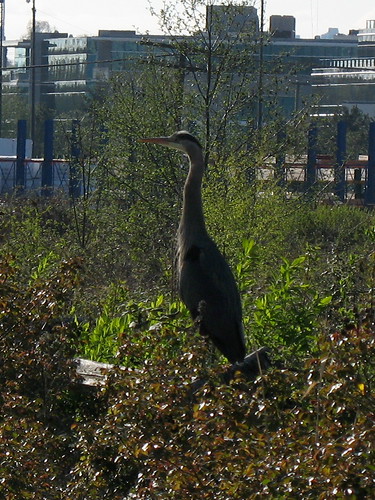
This morning, I just happened to see a Great Blue Heron by Still Creek, about fifty feet from Gilmore. There wasn’t anyone nearby, so I approached very slowly and quietly.

Looking Up

This morning, I just happened to see a Great Blue Heron by Still Creek, about fifty feet from Gilmore. There wasn’t anyone nearby, so I approached very slowly and quietly. The heron seemed very nervous, though, probably not helped by some crow that kept buzzing it. But I still managed to get a few good shots before it got fed up and flew away.

More photos

Book Review: The Five Books of Moses Lapinsky

Wow, that took a while. So much for my New Year’s resolution to read a novel a month, eh?

I started on this book in late January, after skipping through three quarters of the Mortal Engines quartet. Then I was taking a class, which left me with very little time and energy for such frivolities. But the class ended, and on Easter weekend I decided to pick it up again. I was immediately hooked, and devoured it in a three-day binge of more-or-less nonstop reading.

Wow, that took a while. So much for my New Year’s resolution to read a novel a month, eh?

I started on this book in late January, after skipping through three quarters of the Mortal Engines quartet. Then I was taking a class, which left me with very little time and energy for such frivolities. But the class ended, and on Easter weekend I decided to pick it up again. I was immediately hooked, and devoured it in a three-day binge of more-or-less nonstop reading.

I met Karen X. Tulchinsky years ago; she was leading a writing workshop, one night a week for… I don’t remember how many weeks. This was before I started blogging, but I was interested in writing. And meeting guys who were also interested in writing. The workshop didn’t help in that area, but otherwise I thoroughly enjoyed the experience. Ms. Tulchinsky was a great teacher, very friendly and supportive.

Now that I think about it, I’ve gotten the same impression from her previous books—one short story collection and two novels, all dealing with the trials and joys of being a Jewish dyke. I’m rereading some of the stories in In Her Nature, and (to this non-Jewish non-dyke) the history, the culture, the Yiddish, they never seem forced or self-conscious. Just a simple This is who I am. This is who we are. Sure, it’s okay to laugh along.

This latest book is different, though. It’s “queer” only in the loosest sense—only a couple of characters, including the titular narrator, are gay—but it’s still there, part of the tapestry of human experience. Another difference is that it’s not set in the present day (except for the framing narration at the start of each section, most of the action takes place in the 30’s and 40’s), and thus deals much more heavily in presenting Canada as it was then, and Canadian Jews as they were then. We know all the dates and facts about the Depression, about World War II, D-Day, about antisemitism. But the magic lies in making all that history come to life, and Tulchinsky pulls it off, brilliantly mixing the personal dramas with the wide sweep of historical events.

Interesting technique to really grab the reader: Tulchinsky writes in present-tense narration. Nice choice; it felt so natural I took a hundred pages to even notice.

This being a historical novel, the details are made up but the story is true. Toronto youths wearing Swastika badges, fighting Jewish kids; the Christie Pits riot; the disastrous Battle of Dieppe; pogroms in Tsarist Russia. All these things happened. And though Sonny “The Charger” Lapinsky never actually existed, other Jewish boxers lived and fought during the Depression. Though Yacov Lapinsky never existed, the stories he told of his escape from Russia are deeply rooted in reality—a lot more than I realised then, probably. Because, as I said, I’ve been rereading In Her Nature and one of the short stories there (“Canadian Shmadian”) contains some parts of those tales; surely they come courtesy of Tulchinsky’s older relatives.

Most of the novel’s events are related in chronological order, starting on the day after the Christie Pits riot in August 1933. Throughout the book we’re told all the facts, how that day affected the Lapinsky family: Sonny’s anger, Izzy’s brain damage. But in the last chapters take us back to the riot, and even though I knew exactly how things would turn out, I still couldn’t stop reading. Now that’s impressive.

The Five Books of Moses Lapinsky is a masterpiece: engrossing, educational, full of human drama that’s still not without comedy. Tulchinsky has done a wonderful job of honouring her family by creating this ficionalised, though still true, tale.