Geography

A little while back I wrote that, in the blog’s new version, I’d be proudly displaying my daily pictures of Sunset Beach in the sidebar. This is still the plan. And with a much wider layout it’s absolutely feasible. But in the last few days of figuring out widgetizing sidebars (two of them), installing a few more plugins, deciding on all the right navigation aids and so on, I hadn’t really visualised how big a 240 x 180 image was. Stuck on top of the sidebar, I feel it’s becoming a focus point of the whole page.

I didn’t really see this coming, though I probably should have.

A little while back I wrote that, in the blog’s new version, I’d be proudly displaying my daily pictures of Sunset Beach in the sidebar. This is still the plan. And with a much wider layout it’s absolutely feasible. But in the last few days of figuring out widgetizing sidebars (two of them), installing a few more plugins, deciding on all the right navigation aids and so on, I hadn’t really visualised how big a 240 x 180 image was. Stuck on top of the sidebar, I feel it’s becoming a focus point of the whole page.

Which… is not a bad thing, actually. I’ve been thinking for a while that my blog would become less focused on posts, and more on my current projects and photography. But I hadn’t fully grasped how the layout would have to change with the content. And frankly, I still don’t. This is very new to me, and I’m still feeling my way across the weird, wonderful landscape of Web design.

Tagging

I’ve been reading this very excellent blog full of tips and info about Wordpress. Right now I’m pondering tags and categories.

I’ve been reading this excellent blog full of tips and info about WordPress. Right now I’m pondering tags and categories.

Since I switched to WordPress for the current version, I’ve been using categories and not tags. For a while I tried to get a hierarchy of categories, but I just couldn’t decide on the right one. And the end result is a very unbalanced list. “Comics” and “Life” have quite a few posts, while “Music” has two. That never felt right to me. On one hand, it was a constant nudge that maybe I could blog a bit more and flesh out these sparse topics, but I never really got around to it. So the nudge became more “annoyance” than “inspiration.”

The other problem was, a lot of my posts fit into more than one category. What was the point, if a post didn’t fit into a clear hierarchy?

Now I’ve gotten (back) on Flickr, and discovered the joy of tags. And I realize that I don’t actually need categories. If readers want to browse through my blogs, tags will work just as well—along with my Google custom search engine, of course, and all the other Web 2.0 doodads I’ve just started tinkering with.

Of cherry blossoms and insecurities

I’ve just finished the Easter theme for the VGVA site. It’s been a fun and challenging experience, improving my skills and deepening my understanding of many Illustrator features. Pushing the envelope, that’s what it’s all about.

I’ve just finished the Easter theme for the VGVA site. It’s been a fun and challenging experience, improving my skills and deepening my understanding of many Illustrator features. Pushing the envelope, that’s what it’s all about.

Plus, the kudos. Those are always good.

The header graphic was the most complex I’d done so far; in fact, the real challenge (in addition to figuring out the tools at my disposal) was having a clear idea of how the finished product should look. I had to make several changes to the colour scheme along the way and my first draft, was very rough: some rough Paintbrush daubs in place of cherry blossoms, and a few lines sketching out a tree. So the next step, naturally, was to add more details, make everything more realistic.

Or… was it? The problem was that (a) it’d be a lot of work, and (b) even if I pulled it off, it might not necessarily look that good anyways. Maybe realism was overrated; maybe an overabundance of little details would just overwhelm the viewer, and all I had to do was show the essence of cherry trees and Easter eggs and all that springtime goodness. (Granted, the eggs were the easy part.)

For the next few days I kept going back and forth between the two extremes. The fact is, I wasn’t that secure with my visual imagination (something I already blogged about) and so falling back on what my camera saw instead of creating my own interpretation seemed a safe solution.

Well, I think the final product works. I’m still not totally happy with it, but I’ve alway been my own worst critic, so take that with a grain of salt. At the moment I’m heroically resisting the urge to go back and tinker. I can’t find the reference right now, but some years ago I read a quote by Aldous Huxley about regret. He wrote that it was a mistake to continually go back and fiddle with your finished works. No matter how much you polished them they would always have flaws; at some point you just had to let go, learn from your mistakes, and go on to make whole new works. And that’s exactly what I’m going to do: identify what needs work, and then fix it in a later version. I probably can’t do much better right now. A year from now, though? Oh yeah.

Movie Review: Watchmen

Oh, man, that was great.

No, seriously. This is the first time I was very, very pleased with an Alan Moore movie. League of Extraordinary Gentlemen was a massive clusterfuck from the word go, V for Vendetta was pretty good, but not great. This, though? Yes.

Oh, man, that was great.

No, seriously. This is the first time I was very, very pleased with an Alan Moore movie. League of Extraordinary Gentlemen was a massive clusterfuck from the word go, V for Vendetta was pretty good, but not great. This, though? Yes. I was so afraid it would suck—either it would try to stay true to the comic and fail, or it wouldn’t even try, and thus suck as an adaptation. But the movie managed to be both true to the source material and be very watchable. A lot of the backstory and exposition was nicely filled in with various flashbacks and montages, most of which were merged into the storyline pretty smoothly. The only exception I can think of is Ozymandias’ origin. The movie has him expositioning to a bunch of financial bigwigs just before his attempted “assassination,” which felt forced and didn’t reveal all that much anyway. Oh well.

Some stuff was trimmed or tweaked, like Dr. Manhattan’s solitary meditation on Mars, but that’s fine. A couple of scenes were actually improved, like when Nite Owl and Rorschach broke into Veidt’s computer network. In the comic, Nite Owl when entered “RAMESES”, the system helpfully told him the password was incomplete. The movie bypassed this silliness, showing Dreiberg attempting a few passwords before hitting on “RAMESES II”. I also liked the new costumes. It’s a well-known fact that while many superhero costumes look good on paper, they don’t look so good on the big screen (or the little screen). Case in point: the very, very dorky 1940’s Minutemen costumes in the opening montage. Seriously, Mothman, with the wings? Hooded Justice, with that noose around his neck, what’s up with that?

As for Ozymandias’ master plan? Well, I’ve got no complaints. Teleporting a giant psychic squid to kill half of New York might have worked in the comic, but it’d be harder to pull off on the big screen. Ozymandias duplicating Manhattan’s powers? That worked better, and was just as good a testament to his ingenuity.

In short: very impressed, and I’d definitely recommend this movie whether or not you’ve read the original graphic novel.

Back to basics

Redesigning my site is always a special time. It’s a time to start fresh, re-examine all my assumptions and past decisions, ask the hard questions. It starts with the content. What should I keep? What should I add? What should I drop? Before I even get to work on the design, I need to know what I should be designing for.

Redesigning my site is always a special time. It’s a time to start fresh, re-examine all my assumptions and past decisions, ask the hard questions. It starts with the content. What should I keep? What should I add? What should I drop? Before I even get to work on the design, I need to know what I should be designing for.

My Queer History Project? Oh, it stays. Even if I didn’t have any incoming links to it, I’d keep it just because even after 10(!) years I’m still enormously proud of it. It’ll share the stage with the other Web design projects I’ve got going on: VGVA and Team Vancouver

Quotes? For years I used to have lots of quotes, several pages’ worth, including a ginormous one dedicated to the great Terry Pratchett. I decided to drop them in the current version, but I keep going back and forth on it. Thing is, I’m just not sure how to incorporate them in the design. Should I have a random quote in the sidebar? Or a whole, separate page? I still don’t know. Very few of the blogs I’ve seen have have them, so… well, we’ll see. I don’t have to decide today.

Photo thumbnails in the sidebar? Sure thing. I’ll have to find new WordPress plugins to handle Flickr. So far I haven’t seen any that’ll do exactly what I want it to (display a block of square thumbnails just like the Gallery plugin does), but I’m sure it’s out there. Or I’ll do it myself.

In addition to those thumbnails, I plan to show my daily shot of Sunset Beach. Yes, I’ve been keeping that up, though there are a few gaps. Good news for me, Flickr can create slideshows from sets, so I don’t need to futz around in iMovie. Showing off my daily photo will keep me motivated, and provide a bit of regular fresh content.

Twitter and junk? Well, I don’t twitter. Maybe I should? If nothing else, Twitter and Lifestreams and such would be another good way to add content on a regular basis. Why not? My site started out with “essays,” long pieces that took weeks or months to write. Then I moved on to blogging: smaller, more frequent updates. Maybe micro-blogging is the next logical step.

Speaking of which, part of me is still deciding if I want to keep the stuff I wrote “pre-blog,” dating back to 1997. They’re WordPress pages instead of posts, since I don’t have exact publication dates for most of them, and I don’t want to just invent some. Picky, maybe, but that’s just my thing. Part of me is considering dropping the large archive page listing every single post/essay, and doing with category/tag pages (more on tags in a later post). Or maybe monthly archives, but a master list is feeling more and more unwieldy to me. In that case, I’d have to come up with a special page for older writing (like I briefly did, while designing the present version), or drop it entirely.

Decisions, decisions…

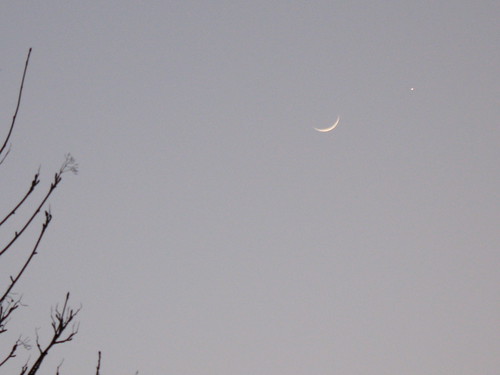
Crescent Moon and Venus

I admit, it was a pure stroke of luck. I was walking home, looking forward to an evening of volleyball, when I happened to look up and saw a lovely new crescent moon. The light was still good so I took its picture, not paying much attention to the nearby bright spot. But it turns out, it’s Venus.

I admit, it was a pure stroke of luck. I was walking home, looking forward to an evening of volleyball, when I happened to look up and saw a lovely new crescent moon. The light was still good so I took its picture, not paying much attention to the nearby bright spot. Turns out, that bright spot is Venus.

Crescent Moon and Venus

Absolutely gorgeous. I had no idea where Venus was supposed to be located that night. And hey: the first photo on this here blog published exclusively on Flickr!

“Listening to the heartbeat of a star in its womb”

Last night I attended a meeting of the Center For Inquiry Vancouver, with invited guest Dr. Jaymie Matthews, mission scientist of the MOST project. MOST (Microvariability and Oscillations of STars/Microvariabilité et Oscillations STellaires) is Canada’s first space telescope, studying minute variations in stars’ light output to understand their inner structure, as well as detecting any planets that may be orbiting them.

Last night I attended a meeting of the Center For Inquiry Vancouver, with invited guest Dr. Jaymie Matthews, mission scientist of the MOST project. MOST (Microvariability and Oscillations of STars/Microvariabilité et Oscillations STellaires) is Canada’s first space telescope, studying minute variations in stars’ light output to understand their inner structure, as well as detecting any planets that may be orbiting them.

In the over 5 years since its launch, MOST has studied hundreds of star systems, upending a few theories, confirming others, and generally expanding our understanding not only of others stars, but our own as well.

The event was named What if Galileo had a Space Telescope? in reference to Galileo’s groundbreaking observations of celestial bodies, which forever altered our perception of the universe and our place within it. Dr. Matthews argues that we are currently going through a similar revolution, what with new cosmological theories like dark energy (to explain why the expansion of the universe is still accelerating), and our continuing quest for Earth-like exoplanets, further putting our home in its proper perspective.

Unfortunately, MOST’s imaging technology doesn’t lend itself to pretty pictures like, say, the Hubble Telescope. Still, the words, simple graphics and animations are enough to fire the imagination. This is head-spinningly exciting science! I’ve read up on some of it over the years, but I’d never heard of MOST and had no idea so much was being done right here in Canada!

To Flickr or not to Flickr

Way back when, as I started to work on my site’s present design, I made a conscious decision not to use Flickr. The disadvantages, as I saw them, were: (a) I couldn’t style it, (b) current incoming links would be broken, and (c) I wouldn’t have access stats. Turns out (c) is not true, (b) doesn’t really apply since I don’t think I have any incoming links to my photos, and (a) is actually not that big a deal.

Way back when, as I started to work on my site’s present design, I made a conscious decision not to use Flickr. The disadvantages, as I saw them, were: (a) I couldn’t style it, (b) current incoming links would be broken, and (c) I wouldn’t have access stats. Turns out (c) is not true, (b) doesn’t really apply since I don’t think I have any incoming links to my photos, and (a) is actually not that big a deal. Hey, I had fun styling my galleries (and fighting with Smarty templates, and learning my way around Gallery’s user interface, which isn’t all that friendly), but I don’t need to do it anymore. Flickr offers much more flexibility in organising my photos, a snazzy interface, rich tagging and metadata, and—more importantly—tons of exposure.

I’m in the process of republishing my galleries on Flickr. All new photos will go directly there.

Oh, and I’ve started another site redesign. It was about time, don’t you think? No details yet, except I am planning to expand the width from 800 to 1000 px. Hah, and what will I do with all that extra space?

Caw!

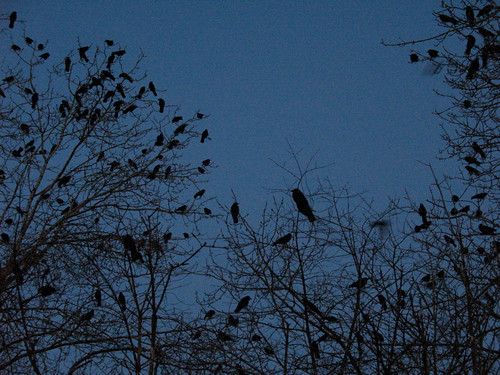
Hey, remember the last time I blogged about crows? Back then I was just on one of their commuting routes. But my present job happens to be very near their roosting grounds around Still Creek and Willingdon. Until recently it was still dark when I left work, so I had so I walked past, oh, a couple of thousand crows, I’d say, settled in the trees along Gilmore Ave. And that’s just a suburb of Crow Central.

Hey, remember the last time I blogged about crows? Back then I was just on one of their commuting routes. But my present job happens to be very near their roosting grounds around Still Creek and Willingdon. Until recently it was still dark when I left work, so I had so I walked past, oh, a couple of thousand crows, I’d say, settled in the trees along Gilmore Ave. And that’s just a suburb of Crow Central. There was no way to avoid walking under them, so I used to pull the hood of my jacket up, afraid of getting shat on. Which hasn’t happened so far, but I’m not keen on tempting fate.

Settling In

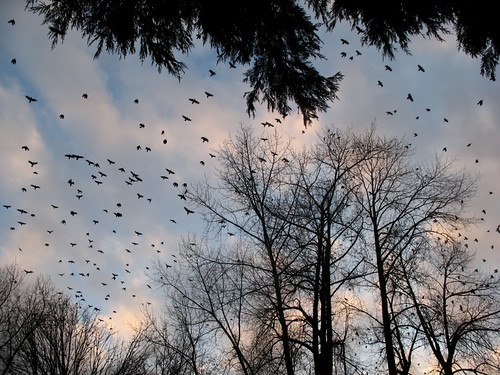
But the days are getting longer and a few times this week I’ve been able to get out of work early enough to see all the zillions of crows on the last leg of their commute, resting on trees, roofs, power lines or any convenient spot. And then, without warning, take off again like a swarm of, well, screechy black birds.

A lot of crows

“There is grandeur in this view of life…”

In the last chapter of The Origin of Species, Darwin recapped all the evidence he so carefully and meticulously presenting for his theory of common descent. And then took a step back to ponder where it was all going, and what it all meant.

In the last chapter of The Origin of Species, Darwin recapped all the evidence he had so meticulously presented for his theory of common descent. And then took a step back to ponder where it was all going, and what it all meant.

When we no longer look at an organic being as a savage looks at a ship, as at something wholly beyond his comprehension; when we regard every production of nature as one which has had a history; when we contemplate every complex structure and instinct as the summing up of many contrivances, each useful to the possessor, nearly in the same way as when we look at any great mechanical invention as the summing up of the labour, the experience, the reason, and even the blunders of numerous workmen; when we thus view each organic being, how far more interesting, I speak from experience, will the study of natural history become!

He predicted that the theory would open up rich new fields of scientific research in biology, geology, paleontology, psychology and anthropology. Armed with the understanding that all individuals of all species are related, however distantly, that species have been shaped by their environments over the eons, scientists would look backwards, and outwards, free of counterproductive labels and dogmas, answering many current questions and discovering even more interesting questions to ask. This prediction would prove to be correct. As Theodosius Dobzhansky wrote, “nothing in biology makes sense except in the light of evolution.”

And then he went one step further:

When I view all beings not as special creations, but as the lineal descendants of some few beings which lived long before the first bed of the Silurian system was deposited, they seem to me to become ennobled.

What ennobles them? Simply having such a long and complex history. They—and all their ancestors—were lucky or tough enough to survive everything Nature could throw at them. Every being now living, worm or eagle, peasant or aristocrat, is descended from a long line of survivors. That’s a pedigree anyone should be proud of.

Judging from the past, we may safely infer that not one living species will transmit its unaltered likeness to a distant futurity. And of the species now living very few will transmit progeny of any kind to a far distant futurity; for the manner in which all organic beings are grouped, shows that the greater number of species of each genus, and all the species of many genera, have left no descendants, but have become utterly extinct.

Is it all doom and gloom, though? Not at all.

As all the living forms of life are the lineal descendants of those which lived long before the Silurian epoch, we may feel certain that the ordinary succession by generation has never once been broken, and that no cataclysm has desolated the whole world. Hence we may look with some confidence to a secure future of equally inappreciable length. And as natural selection works solely by and for the good of each being, all corporeal and mental endowments will tend to progress towards perfection.

I don’t know about that “perfection,” but hey, that’s Victorians for you.

It’s interesting to note how Darwin’s attitude contrasts with that of creationists, then or now. To them, the idea of being related to apes is just as abhorrent as the idea the Bible isn’t literally true. Animals aren’t ennobled by their connection with us; it’s we who are demeaned by our connection with them. The only way Humankind can be seen as special is through our creation, not our history or achievements. And they certainly don’t look forward to a far distant future where our descendants—however different they’ll be from us—will continue to thrive.

The book concludes with a final appeal, not to the truth, but the beauty of his theory.

There is grandeur in this view of life, with its several powers, having been originally breathed into a few forms or into one; and that, whilst this planet has gone cycling on according to the fixed law of gravity, from so simple a beginning endless forms most beautiful and most wonderful have been, and are being, evolved.

Darwin’s no poet, I grant you, but this passage works. I’ve said it before, and I’ll say it again: the theory of evolution—with its notions of deep time and the fundamental interconnectedness of all living beings—tells a far more satisfying story than any creation myth our various cultures have cooked up. Our long journey from the trees—and before that, from the swamps and the seas—has made us what we are, flaws and all. We dishonour our ancestors by ignoring their struggles, their achievements, and yes, their failures. We honour them by remembering their lives, and continuing the journey they made possible for us.

Happy 200th, Mr. Darwin.