Vancouver WordCamp

So I’m finally blogging about WordCamp. I had a great time, met some cool people, and learned so much I almost needed an extra brain. Well, I had my iPhone, does that count? Now I just need to digest everything I’ve absorbed and apply it to my present and future projects.

So I’m finally blogging about WordCamp. I had a great time, met some cool people, and learned so much I almost needed an extra brain. Well, I had my iPhone, does that count? Now I just need to digest everything I’ve absorbed and apply it to my present and future projects.

It was such a beautiful day. I strolled down to Vanier Park via Burrard Bridge, unused to getting up so early on a Saturday, but not really minding, because the streets were peaceful and quiet. Then I got a little lost, because I wasn’t too clear on just where the Vancouver Museum was. Turns out, it’s attached to the Planetarium. Huh. How long has that been going on?

Socializing Your WordPress Blog

The first presentation was by Nadia Aly, showing various social media tools to add to your blog. Facebook, Twitter, Digg, Stumbleupon, all these and more should be used to bring more readers in, and add value for your established readers.

  • Tweetmeme, a retweet button. Also shows how many times a post has been tweeted. Available as a WordPress plugin or standalone as a bit of Javascript code.
  • Facebook share. Same as above, but with Facebook.
  • Social Bookmarking Reloaded adds a series of graphical links to all kinds of social media sites, from Facebook to Delicious to… a whole bunch I’ve never heard of. Seriously, there are over 60 options.
  • Flickr Photo Album, a plugin that allows you to insert Flickr photo sets or individual photos in your posts
  • WP Followme adds a Twitter “Follow Me” badge to your blog
  • Facebook Like button plugin: exactly what it says on the tin
  • Twitoaster automatically tweets your posts as they’re published.

And that’s only the tools Nadia explicitly recommended, I’m sure there are a million more.

WordPress Dev Environments: MAMP and WAMP

Wouldn’t it be great if you could set up a WordPress install right on your own machine, to poke and tweak and experiment to your heart’s content, play with the most unstable beta builds without worrying about taking down your live site? John Biehler introduced us* to MAMP (Mac, Apache, MySQL, PHP), a completely self-contained environment separate from the existing Apache server on MacOS. Wish I’d known about this before; in the future I won’t have to set up a subdomain with a separate WordPress build to test new themes. Hey, live and learn.

(* Well, me, at least)

WordPress As CMS

A panel of three speakers (Cameron Cavers, Christine Rondeau and Dave Zille) discussed how WordPress can be used as a CMS, using some great examples of “non-WordPress-looking” sites. Here’s one. And here’s another. They argued that it’s even appropriate for small static sites, because though it may take a little more time to set up, updating becomes much easier. Plus, you’ve got things like the versioning process, to help clients not panick. With the coming of WordPress 3.0, with its custom post types and menuing system, CMS usage will become even easier, though still limited. For instance, there’s no built-in approval process, though there are kludgy workarounds (e.g.: conditional displays on certain custom fields, each one acting as a signoff).

Some interesting CMS-related plugins mentioned in this discussion:

  • Improved include page: lets you display multiple subpages on a template. Great for reusing snippets of text without mucking about with widgets!
  • Pagetree lets you view your pages in a tree structure, in the admin panel. Great if you have a complex page hierarchy!

Being Curious for a Living

Why ask why? Lauren Bacon argues that asking questions of your clients leads to better sites and loyal clients because you get to the meat of what they really need instead of what they think they want. You want a new widget? What purpose will it serve, exactly? How will this fit in your business strategy? WHY DO YOU WANT THIS NEW FEATURE? Answers like “Everybody’s doing it” are not acceptable.

Instead of writing from my notes, why don’t I link you to Lauren’s post on her own presentation?

Designing For WordPress

Colin Ligertwood is the speaker here (and I am just totally in love with his logo). Among other things, he coaches designers in working with WordPress. Unfortunately I didn’t take extensive notes for this talk; I think it’s because not a whole lot was new to me.

  • He advised designers to create our themes from scratch. The problem with adapting existing themes is that there may be unknown design issues, unnecessary features, or may not be appropriate to the content
  • Speaking of, content may be unpredictable, so we should design accordingly. Allow for both very short and very long posts
  • Keep navigation simple
  • The 960 grid system is really awesome, and I can vouch for it. I’ve already used it a bit for some quick prototyping.

WordPress and Drupal

WordPress is:
joyful, resourceful, quick

Drupal is:
flexible, dragon-slaying, comprehensive

Amye Scavarda comes to us all the way from Portland, to talk about how to decide between WordPress and Drupal for a given project. What sets Drupal apart from WordPress is that it’s so powerful. It is a sword, and if configured right it will slay any dragon you want; but use it wrong and it will cut you.

Will you need many different user roles? Are you building a large content-heavy multisite? What do user needs? How much training?

The dividing line between WordPress and Drupal is blurring just a tiny bit, though; with its new features, WP 3.0 is becoming a pretty robust CMS (as we’ve already seen). This cross-pollination is a good thing in the end. It shouldn’t be WordPress versus Drupal, both have different strengths and different niches.

Here are the slides for Amye’s talk

Parent-Child Themes And Frameworks in WP 3.0

The bottom line here, say Tris Hussey and Catherine Winters, is that WP 3.0 is an evolutionary, not revolutionary, update. Custom post types, just to pick one example, were around in 2.9, there just wasn’t any real front-end to manage them. Still you’ve got a lot of really neat stuff in this version, like custom menus and child themes.

Child themes are great. Tris gave a simple example of a child of Twenty Ten, the new default WordPress theme. All it took was one CSS file, consisting of two lines, in addition to a few bits to refer to the parent: one overriding the header graphic, and one to show a new font. Simple, but it got the point across. It looks like all you need in child themes is to add whatever styles (and templates? I’m not too clear on that) you want to override. Easy-peasy.

Get Found Easier: SEO Tips For WordPress

Tell you what, I’ll just link to Mark McLaren’s site, McBuzz.com. It’s got the slides for his talk. Bottom line, WordPress is already quite good at SEO, with its customisable permalinks, post description, etc… Of course, you have to choose good keywords (and figure out which keywords will actually lead people to your site), but WordPress can’t do everything, eh? There are other tools to help you along, such as:

Closing: Art and Technology are Old Pals

Goddamn, but Dave Olson is fucking hilarious. Oh, also smart and insightful. He took us on a roller-coaster ride through his past, mixing and matching metaphors with the greatest of ease, from the bottom of the Grand Canyon to Moab, Utah, from floppy disks to WordPerfect to CB radio to blogs. Art and technology together, open technologies and open data, people chatting with each other as equals, they’ve been around for a lot longer than I (for one) thought. And we, valiant WordPressers, are continuing that proud tradition.


WordCamp ended around 4:00, with a social on Granville Island at 6:00. How to kill a couple of hours? Well, first, I could explore the Museum of Vancouver. They were kind enough to give WordCamp attendees the run of the place for free, so I got to look at some fascinating exhibits on Vancouver’s history, and a bit about shoes. Kinda cool, but anyone who knows me would tell you I’m not one for fashion.

Then I went for a walk. The weather was still sunny and fine, so I moseyed along the seawall towards Charleston Park and Stamp’s Landing. Very pretty neighbourhoods, with a spectacular view—close to downtown, close to everything, lots of bike and pedestrian access, what’s not to like? If I’d had my camera I would have taken more pictures, but all I had was was my dying iPhone. Still, here’s something, mostly because it intrigued me:
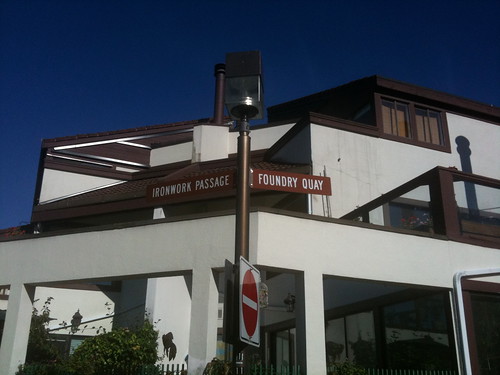
Ironwork Passage & Foundry Quay

Ironwork Passage & Foundry Quay

Now those are some weird street names for such a residential neighbourhood. But then I thought back to the history exhibit, especially this map right here (the museum had a colour version). Back in the day, this place, as well as Yaletown, were places of industry. Did you know there used to be a rail bridge linking downtown and what’s now Vanier Park? How things change. Nowadays, the only train you’ll see in Yaletown is the old locomotive in the Roundhouse.

Had another blast from the past in Stamp’s Landing, too, but that’ll have to wait for another day. It’s a much longer story, and not connected to WordCamp.

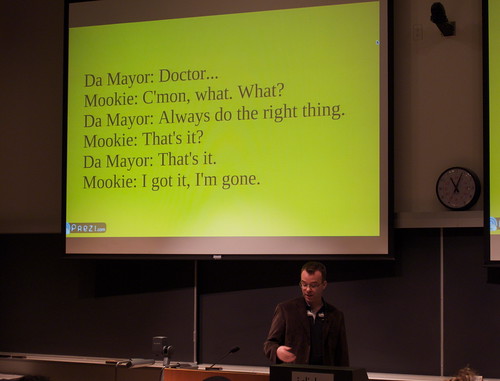
Progress means…

In the last two years I completed the VGVA.com redesign, to much applause; I began and will soon finish another redesign, which introduced me to an honest-to-gawd CMS (WebGUI, to be precise). And yes, I already knew Wordpress, but I’d only adopted that in the previous year. Recently I’ve begun two more projects, one (volunteer) as part of a team of developers, another as the solo tech guy for a fledgling online commercial venture.

Hey, remember when I wrote

How much do I really know about Web design? Sure, I read a lot of designers’ blogs, but I’ve got exactly two sites under my belt: this one right here, plus another one for an online RPG I’m no longer a part of, that I redid maybe six years ago. That’s it. Just two. Not a great portfolio. A lot of people will be judging this, and judging me on it. Am I really up for this challenge?

In the last two years I completed the VGVA.com redesign, to much applause; I began and will soon finish another redesign, which introduced me to an honest-to-gawd CMS (WebGUI, to be precise). And yes, I already knew WordPress, but I’d only adopted that in the previous year. Recently I’ve taken on two more projects, one (volunteer) as part of a team of developers, another as the solo tech guy for a fledgling online commercial venture.

I’m fretting especially about project (b), because though it may be possible to implement it in WordPress, we’re still hammering out the requirements and I may have to turn to Drupal. Which would mean learning Drupal. On the other hand I’ve been meaning to do so for a while now, not least of which because it’s an extremely marketable skill, and now I have a good excuse. On the gripping hand it’s intimidating, because the project’s bigger and the stakes are higher.

So yeah, the fears and doubts are still there. The difference is, my comfort zone is much larger now, and I’m getting insecure about bigger and scarier things.

And that, my dears, is progress.

Accentuate the Visual

I’ve been working on a redesign of this blog for a while now, on and off, and it’s finally close to done. At the same time I’m updating a lot of my posts to add more inline photos.

I’ve been working on a redesign of this blog for a while now, on and off, and it’s finally close to done. At the same time I’m updating a lot of my posts to add more inline photos. It hit me, looking at other more photo-intensive blogs (like the lovely Life for Beginners), that my posts are mostly unbroken walls of text. Even those that aren’t, just have a few modest thumbnails linking to their respective Flickr pages.

Well, that just won’t do. Not only will more photos make my brilliant words easier to read, but visitors won’t have to click to another page to get the story. It’s win-win!

I’ll be adding other elements, too, like gravatars and pull quotes. Maybe an abstract for the very long ones. And drop caps, too? We’ll see. Thinking visually is still new to me, but I’m getting the hang of it!

Northern Voice 2010

So, Northern Voice: the annual blogging and social media conference, held this year at UBC’s beautiful Life Sciences Centre. It was my first time; in fact I only heard about this event a few weeks ago. It sounded like a great time, and it truly was: two days of learning, nerdery and camaradery! I met some amazing people, attended talks and workshops for all tastes, from the technical to the social to the political to the academic, and overall basked in the presence of my fellow bloggers.

Me

So, Northern Voice: the annual blogging and social media conference, held this year at UBC’s beautiful Life Sciences Centre. It was my first time; in fact I only heard about this event a few weeks ago. It sounded like a great time, and it truly was: two days of learning, nerdery and camaradery! I met some amazing people, attended talks and workshops for all tastes, from the technical to the social to the political to the academic, and overall basked in the presence of my fellow bloggers.

And that was the biggest thrill of all. No blogger is an island, but the fact is I have been pretty isolated, since day one. Sure, I’ve followed a lot of blogs, read a few books and so on, and they’ve taught me all I know. But the flow has always been one-way. I wasn’t interacting with the authors online, let alone in person. But here I was, not just learning but dialoguing and connecting.

And it took me out of my comfort zone, in other ways: I knew very few people there, which was uncomfortable since I’m not the most outgoing guy around (more on that later). However, I did meet up with a couple of people I knew on Twitter, so that was all right. And even by myself, I could dip into the Twitter stream, drink in everybody else’s posts, and once in a while see one of mine retweeted.

Here are some of my thoughts on the talks I attended.

Day One Keynote Speaker: Bryan Alexander

And we’re off! I found this speech kind of rambly, as it meandered back and forth between storytelling, mystery, and how social media are misrepresented in mainstream media. That’s okay, though, because Bryan Alexander is a fantastic speaker, engaging and funny, working the crowd without any PowerPoint slides. A great way to start the conference!

Gov 2.0: Social Media in Canadian Government

How involved is government in social media? The answer, at least at the federal and provincial level, seems to be: not much. Politicians are generally terrified of any risk of “gotcha” journalism, and civil servants are usually set in their ways and don’t want to use newfangled tools. And citizens are left out in the cold, unable to more efficiently engage with the people representing them. Vancouver, however, is a lot more open with its data. The speakers also made the excellent point that it’s not about the tools, but the process. Really using social media means more than just slapping a wiki here or a twitter account there, it means a fundamental rethinking of the entire process of governing and decision-making.

Good Science: It Takes An (Online) Village

Kids today know more about Pokémon than biodiversity. What’s the solution? If you said, “how about a science-based trading card game, to both educate and entertain?” then David Ng is way ahead of you. Behold, Phylo! What an awesome idea!

Finding Your Voice

What do you write about? And how do you write it? That’s something I’m still struggling with, even after years of blogging. Could Monica Hamburg show me the way? Well, sort of. Her main point was, simply “be yourself.” The hard part about that is I to know the self that I’m being. Also that it’s okay to suck at first, and to be unknown. It gives you freedom to experiment. Good stuff, and encouraging to someone who still feels like a beginner at this whole writing thing.

The nuts and bolts of SEO

Kind of interesting, but mostly focused on commercial blogs. Alexandre Brabant gave some numbers on ideal post length and keyword seeding which I’ve forgotten now, and don’t really apply to this here personal blog. On the other hand, they may be useful for other projects I’ve got going on…

Overcoming Social Anxiety

Kimli rocks! Oh, I could totally tell how nervous she was during her talk, but then I would be too. She was powerfully frank about her social anxiety, how it used to cripple her life, and gave some tips on how to deal with it. Basically: events like Northern Voice are pretty good for introverts, since the attention will be on the speakers and not yourself; don’t be intimidated by Big Name Bloggers, since none of us are cooler than others, no matter how many hits we get on our blogs or how many times we’ve been interviewed by the CBC.

She had a few more pieces of advice (you can see her slides here), but that’s mostly what I took out of her talk. I’m still working on the whole no-intimidation thing. And on most of the other stuff, to be honest.

Incidentally: those Justin Bieber masks in her slides are CREEPY with a capital CREEP.

Social Media Buffet

As the name implies, this is a half-dozen little parallel workshops on various technical issues. None of the day’s remaining talks really appealed to me, so I hung out in the atrium and got a bit of free web design and WordPress advice.

Day 2 Keynote Speaker: Chris Messina

Chris is a long-time open web and open source advocate; also, the inventor of the Twitter hash tag. That makes him okay in my book. His speech (also done without PowerPoint!) was focused on the future of the Web, or at least a possible, dark future: with more and more consumer products like the iPad or WebTV discouraging use of the address bar, and with corporations always trying to clamp down on content, people will simply surf in the channels chosen for them. This will lead to a fractured, bland Web. It’s a sobering but not depressing speech; that future doesn’t have to happen, if people like Chris (and you and me) can work to avoid it.

How To Do Good on the Web

Mahatma Gandhi said: “The best way to find yourself is to lose yourself in the service of others.” But what does that mean? What is good? And how do you do “good” online? Darren Barefoot, in this funny and inspiring talk, gives a few answers. Doing good on the Web, he says, can be as simple as clicking “Like” on something your really like on Facebook, or as complex as setting up something like Kiva.

He gave us a few practical ideas for doing good, such as Nabuur.com, which I’ve signed up for, and Procrasdonate, which I’ve installed on my browser. Should be interesting.

(Also, I think it’s during this talk that I installed Evernote, which totally rocks.)

Coping With Social Media

It’s addictive, isn’t it? There’s so much good stuff out there, a constant stream of tweets and posts and lovely information, that twenty-four hours aren’t enough to sample it all! How does one cope? Well, Alexandra Samuel argues, social media doesn’t have to be the problem. There are ways to make it work as a coping mechanism. For example, cleaning out your inbox can seem overwhelming, but it actually forces you to sort through your contacts, establish filters and rules, and make some hard decisions about what you let in. Tough, but it’s transformative!

Location sharing sites

What’s interesting is that the producers of location-sharing services like Gowalla, Foursquare, etc… don’t have any idea what they’re really for. And apparently, neither do users. Are they games? Are they a way to mark your travels? Connect with other people? They can be all that and more.

Sometimes a lot more. Last month a 54-year old North Vancouver man was accused of sexually assaulting a 15-year old boy who he apparently tracked down through Grindr. This just goes to show the risks inherent in letting other people know your past or present whereabouts. Issues of privacy and personal risk will probably multiply now that Facebook is about to roll out geolocation.

Art and Social Media

I’m not an artist, but I loved the four speakers’ stories of using social media to find, and connect with, their audience. Mainly, it involves taking people behind the scenes, see part of the creative process, etc… That sort of thing is apparently very popular, and I see why. You get to connect with artists as people, not just producers of art. And who doesn’t love a good behind-the-scenes documentary?

I wonder if I could do something similar, for my occasional graphics design work. Who know, it might put me in a different mental space, and help the creative process. Gawd knows I could use some help with that, when it comes to graphics.

If Machiavelli and Montaigne Grew Mushrooms

And what better way to end the conference than with some high-falutin’ abstract talks on the principles of social media?

Dave Cormier started us out by connecting Socrates, Machiavelli and Montaigne, how they related to books, and how this can teach us about books and social media today. Now, Socrates hated books (which I guess were still kinda new in the 5th century BCE), because to him, the only real way to develop and communicate philosophical ideas was through personal discourse. Books not only froze ideas, but broke the entire discussion process. Machiavelli, however, loved his books. He wrote something to the effect that in his library, he could commune with the Ancients. Maybe Socrates was amongst those Ancients; if so, I don’t think he would have appreciated the irony. Montaigne also loved his books and went one step further by scribbling notes in them, actively dialoguing with the authors. Was it vandalism, or 16th century blogging? Montaigne saw that books were instruments of communication that were meant to be used, not venerated on a pedestal.

Steampunk Tyranny

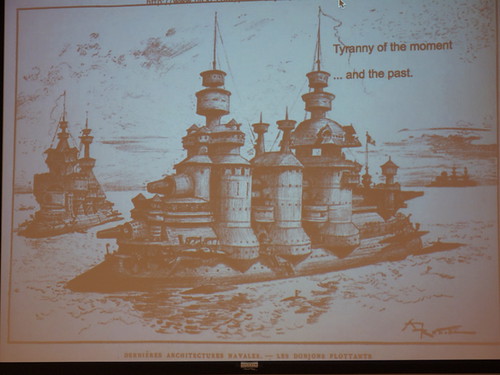
Tyranny of the moment… and the past. Future technology imagined in terms of the present. A lovely steampunk moment.

Thing is, Socrates was right. As necessary as books are, they do have their own tyranny. What can social media do about that? What sets them apart from traditional media is not the content, but the connection between bits of content, and between reader and author. This is the metaphor of the rhizome, connected shoots that have no centre, like knowledge spreading out in all directions.

Though, not to be pedantic, I don’t think mushrooms fit the metaphor. Unless they all grow rhizomes. But whatever, the alliteration’s nice.

Jon Beasley-Murray’s talk, “Knowledge 3.0”, was depressing and frustrating. He saw a drop in the level of critical thinking and quality of education offered by universities and newspapers, and essentially blamed social media for it. Okay, I’m putting words in his mouth, I know. He never actually said anything more than social media being “complicit” in this process, but he never discussed any other factors. The democratisation and physical scattering of knowledge and education is a complex thing, and may cause problems of its own, but I’m convinced that social media is not to blame for sloppy education and news. Correllation is not causation.

So that was a bit of a sour note. But everything else was gold. I can’t wait for next year!

Old poetry brought to life

Excellent post to cap off National Poetry Month, right? This is a clip of Natalie Merchant singing a selection of songs from her latest album; all the songs in this album are adapted from old poems.

Ghosts, right? They have nothing to say to us… obsolete, gone… Not so! What I really enjoyed about this project was reviving these people’s words, taking them off the dead, flat pages, bringing them to life.

Excellent post to cap off National Poetry Month, right? This is a clip of Natalie Merchant singing a selection of songs from her latest album, Leave Your Sleep; all the songs in this album are adapted from old poems.

My favourites in this video are Charles Edward Carryl’s The Sleepy Giant (00:15) and E.E. Cummings’ maggie and milly and molly and may (8:00). I’ve purchased the whole album from iTunes, and I’m sure I’ll have more favourites before long.

Bloggers… Bloggers Who Need Bloggers…

Last night was my first time with the Vancouver Blogger Meetup. Fun times! Cool geeks, good food, and I even got my first close-up look at an iPad!

Last night was my first time with the Vancouver Blogger Meetup. Fun times! Cool geeks, good food, and I even got my first close-up look at an iPad! It’s a pretty sweet machine, with some awesome-looking software, though I won’t be getting the first version. And I’m still not convinced the onscreen keyboard will be too comfortable, though I’m told the iPad would be mostly used for consuming content, not creating it. Fair enough, I guess… and if a lot of typing is needed, external keyboards are available.

Anyway. Bloggers. This is something I’ve been missing, though it’s only now that I consciously realise it: a community. I’ve been blogging on my own, and having fun with it, but connecting with other bloggers is sure to inspire and energise me.

Plus, I also registered for Northern Voice. Six years and I never heard of it until last night? Well, there you go. Better late than never. Mental note: buy an portable charger for my iPhone, cos the battery will never last the whole day.

Chicken wings and the smell of lilac

Indoor volleyball season ended this weekend. I’ll miss getting up early Sunday morning to try to drop into C1; waiting at the door for Tony to come with the key; I’ll miss playing for over 7 hours all day, with only a 2-hour lunch break. I’ll miss dinner at the Fountainhead afterwards. This Sunday was especially nice, with those yummy honey-garlic chicken wings I haven’t had in a while, the lilac tree blooming next to the patio, and all the West End walking past on such a fine spring evening.

Indoor volleyball season ended this weekend. I’ll miss getting up early Sunday morning to try to drop into C1; waiting at the door for Tony to come with the key; I’ll miss playing for over 7 hours all day, with only a 2-hour lunch break. I’ll miss dinner at the Fountainhead afterwards. This Sunday was especially nice, with those yummy honey-garlic chicken wings I haven’t had in a while, the lilac tree blooming next to the patio, and all the West End walking past on such a fine spring evening.

Not sure I’ll be missing Friday night Rec dropin all that much. It’s fun, yes, and I get to hang out with friends who don’t play in the Sunday divisions, but I’m learning bad habits, especially in reffing, and the play level isn’t doing me any favours. And sometimes, there were other things I could have been doing on a Friday night.

So you know what? Next year I won’t be making Rec dropin a priority.

This year I’ve been dropping into C1 a lot more; I decided I needed to be a little more active in developing my skills so that (hopefully, someday) I can register for that division. It’s a hell of a workout and pretty stressful because the regulars are very demanding, way more than I2. Which is okay, right? After all, the “C” stands for “competitive”, not “comfort zone”. It’s been worth it; my play is still inconsistent but I think I’ve improved. Enough to ace the tryouts in the fall? Well, we’ll see.

This is what happens when you mix science and religion

Dr. Hugh Ross is full of shit.

Sure, he’s obviously a smart guy. He knows a lot about science–Astronomy, Mathematics, etc… But he’s also a biblical literalist, and what’s worse, he’s trying to support the one with the other.

Dr. Hugh Ross is full of shit.

Sure, he’s obviously a smart guy. He knows a lot about science—Astronomy, Mathematics, etc… But he’s also a creationist, a biblical literalist, and what’s worse, he’s trying to support the one with the other.

Last night I went to a debate sponsored by CFI and Reasons to Believe: “What’s right and wrong with Christianity?”, taking place at Tenth Avenue Church. Dr. Ross took the “right” side and spoke first, basically blathering on about how modern science fit so well with the biblical creation story, therefore it has to be true. Humans are so unlikely, what with our big brains with no survival value, therefore we must have been designed. Christianity is unique, therefore etc… And so on.

All this delivered at a well-rehearsed breakneck pace, too fast for the audience to do more than go “wait… what?” before moving on to the next bible verse or pretty graph or inspirational urban legend. It was dizzying, frustrating, incredibly condescending, but really not that surprising. I didn’t know Dr. Ross, but I’d read and heard similar “christianity is right and other religions are wrong neener neener” arguments before and, honestly, theists never come up with anything really new.

Which is actually okay, for his usual audience. Because even though last night the people filling the pews were mostly atheists and skeptics, I had the definite impression Dr. Ross was only used to preaching to the choir. Everything he said was designed to appeal to Christians, to reassure them that their beliefs were right. There was nothing there for nonbelievers, or even believers of other faiths. In fact, he kept using loaded terms, like “atheist scientists,” that implied a definite us-vs-them attitude. I’ve seen that before, too, in that creationism vs evolution debate a few years back.

Brian Lynchehaun (who I remember from Skepticamp), addressing the “wrong” side, didn’t go into historical truth or scientific truth, though he easily could have. His speech (much shorter, less rehearsed) dealt with the morality of Christianity; his thrust was that the Bible was not a perfect moral code. In fact, it wasn’t even an especially good one. Its commandments are inconsistent, and its elevation of faith is dangerous because it leaves you open to a whole slew of scams that wouldn’t work on skeptics.

This is what happens when you don’t keep religion and science separate: leave the door open for God or mysticism in your theories and you’re opening a Pandora’s box, because there’s no end to what you can put in. You say Jesus’ body was never found? Maybe the apostles took him. Maybe the Pharisees took him. Maybe he rose from the dead. Maybe he was beamed up by time-traveling Christians out to clone a Messiah 2.0. Mr. Lynchehaun did point out that “God” as an explanation is no less silly than “superpowerful little green men.”

But Dr. Ross isn’t even doing that. He doesn’t respect science, he’s just whoring it out to service his pre-existing beliefs. He’s wrapping the bible in a white lab coat to give it extra prestige for his ignorant flock, thereby twisting and demeaning both spheres. And it’s ironic that he and his audience even want a reason for believing in Christ. What it tells me is that, if they seek (pseudo-)scientific justifications for their faith, then it’s probably a pretty weak faith to begin with, and they’re willing to grab at any straw to hold their house of cards together*. Frankly, I’d have a lot more respect for Christians if they just appealed to simple faith to defend their beliefs. They’d still be wrong, sure, but at least I’d respect the honesty.

(* Apologies for the mixed metaphor)

Movie Review: Clash of the Titans (2010)

Well, now I totally want to play God of War and Dante’s Inferno

Well, now I totally want to play God of War and Dante’s Inferno

A nice little movie, following in the original’s mix-and-match approach to Greek mythology, though adding the whole “rage against the heavens” plotline. Pretty entertaining, with some nice special effects, though a couple of fight scenes did those annoying rapid-fire cuts that actually hide the action, which action-movie editors seem so fond of these days.

I’m not going to compare this movie with the 1981 original; all I’m going to say is that they’re equally cheesy, both having shallow storylines and an overreliance on fancy effects. Still, they’re both fun, so I’m not complaining.

It’s not easy being a girl

Well, that was kind of fun. I don’t think I’m doing it again in a million years, but still. Fun.

So last night my volleyball league had our end-of-year party at Celebrities. Since the party is also our only fundraising event for the year, we wanted to bring in a big crowd. Something we’d never done before. The answer? The board would put on a drag show. After a bit of discussion we settled on George Michael’s “Too Funky” for music; the only female board member would be dressed as George, and the rest of us would walk around and pose like the models in the video. There was a bit more to the choreography, but that’s about it. Nothing too fancy.

Well, that was kind of fun. I don’t think I’m doing it again in a million years, but still. Fun.

So last night my volleyball league had our end-of-year party at Celebrities. Since the party is also our only fundraising event for the year, we wanted to do something we’d never done before, and bring in a big crowd. The answer? The board would put on a drag show. After a bit of discussion we settled on George Michael’s “Too Funky” for music; the only female board member would be dressed as George, and the rest of us would walk around and pose like the models in the video. There was a bit more to the choreography, but that’s about it. Nothing too fancy.

I wasn’t really keen on doing it, since I’d never done drag before, never felt comfortable performing in front of an audience, and frankly was afraid of looking like a hot mess. Of course, I realised I was totally going to look like a hot mess, but I had to just go with it and have fun, and it would all be over in a few minutes.

Self-consciousness aside, my biggest worry was whether I’d even be able to walk in heels. That part wasn’t so bad, though, since the shoes I ended up using (borrowed from a friend, along with my entire outfit) had fairly modest 2-inch heels. As long as I remembered to step with the toes first, I could get from point A to point B pretty efficiently, though not that gracefully.

And I learned something else, too: being a woman takes a lot of work! Hair, makeup, dresses, bras, shaving various bits as necessary, and the aforementioned shoes. But that’s the price you pay for being beautiful, I guess. Not that I really felt that beautiful, once the initial thrill wore off; with all due respect to my makeup artists (no, seriously), my face in makeup just looked weird, like some alternate-universe Joker-ised version of myself. That’s just me, though. The feedback I got from my performance ranged from “Good job, you were great!” to “scary but nice” to “I’m gonna need therapy.” So… on average, I did okay? Meh, I don’t really care. I did it once, kind of enjoyed it, we raised money, and now it’ll make a good story.