Comic Book Review: Shadows Fall

Seventeen years ago when he was a teenager, Warren Gale made a choice that cost him his soul. Never noticing its absence, Gale went on to have a perfectly safe, dull and predictable life, while his soul—a lonely, hungry shadow—drove hundreds of people to suicide. But now his soul wants to rejoin with him… and for the first time in a long while Warren’s life is about to become very interesting.

Seventeen years ago when he was a teenager, Warren Gale made a choice that cost him his soul. Never noticing its absence, Gale went on to have a perfectly safe, dull and predictable life, while his soul—a lonely, hungry shadow—drove hundreds of people to suicide. But now his soul wants to rejoin with him… and for the first time in a long while Warren’s life is about to become very interesting.

Shadows Fall is one comic that’s lost none of its awesome magic. In my original review I called it “one of the best comic books I’ve ever read,” and I feel it’s only gotten better in the intervening years. This 6-part Vertigo miniseries (published September ’94–February ’95) doesn’t try to deliver any Big Message, or get bogged down in pseudo-profound mysticism: only sweet, distilled horror that gives me chills to this day. Contributing to the unsettling atmosphere are John Ney Rieber’s writing, alternating between perfectly mundane, beautifully lyrical, and unspeakably creepy—especially the dialog for Gale’s soul, semi-structured jumbles of words that feel like blank verse—and John Van Fleet‘s harsh, grainy art, perfect for the run-down and depressing cityscapes.

The first character we meet is the soul’s latest victim: Renee, a homeless schizophrenic woman who believes she is a beloved queen, adored by all her subjects but also beset by unknown enemies, waiting for her “Prince Randy” to come and rescue her. A sort of humanoid shadow touches her… and without a word, she walks blankly onto the freeway to get killed. Cut to Warren Gale, a pretty nondescript man, in colourless nondescript clothes, neither ugly nor especially attractive, holding down a boring job, with a staggeringly dull routine, no strong emotions, no friends, no life… and no shadow. As we see that night, his soul occasionally visits him in his dreams to share the more interesting lives it has taken. He never remembers these dreams in the morning, and is in fact completely unaware of his serial killer shadow.

Here we learn the true horror of how the shadow kills. It doesn’t slash or bite or hurt its victims physically. All it does is tell them the truth: to rip apart the illusions and the lies, to make them see how small and pathetic their lives are, so they have no choice but to kill themselves. In Warren’s dream we see the world through Renee’s eyes, and it really was a beautiful world. The colours were richer, the people were prettier—Renee herself looking a bit like a younger Elizabeth II. She was happy, full of hope for the future and love for her subjects. But the truth was, few people in her “kingdom” even noticed her, and fewer cared. There was no Prince to come and make the world right; Randy was just some guy who knocked her up thirty years ago, then married another girl (who he’d also gotten pregnant, and with whom he’s still married) after Renee had an abortion. He moved on but it seems Renee never did; in the end she had nothing but her dreams and lies to sustain her—sweet, harmless lies that Gale’s shadow gleefully ripped away.

The shadow seems to mostly prey on people whose sense of self is weak, or are repressing a core of darkness. Yet the beauty of it is, they aren’t faceless victims. We get to know and empathize with them even as the shadow is dissecting their lives. As pitiful or evil as the victims are, they’re still human. And nobody deserves to die like that.

As morning comes the shadow leaves, with a promise.

So sweet brother
I wonder as I go
As you go about your day Gale
Do you ever miss your soul?
One day Gale
We will be one again

And as the shadow leaves, readers get their first look at Shen, a magician who knows more than he reveals (but less than he’d like to believe), and is dedicated to bringing down Gale’s soul by whatever means necessary. He abducts Gale and forcibly reveals the truth and cause of his fractured existence: a stupid choice that cost an innocent her life. As a teenager Gale held up a convenience store just as a cop happened to be outside. As he ran from the scene of the crime, the cop shot at him and hit Alice, a neighbourhood child. At that exact moment, Warren’s shadow was covering her hand. He kept running, but Alice held on to the shadow somehow. (The exact mechanics of this soulectomy are never explained, and that’s fine. It’s magic; I don’t need any more explanation than that. Alice was just some kid; she didn’t have any special powers, except for being Warren’s only real friend. So: guilt on one side, innocent friendship on the other, a violent death and a wild stroke of luck, all add up to a severed shadow? Works for me.)

Confused, disoriented and, for the first time, feeling guilt over Alice’s death, Warren goes to visit his old neighbourhood. Surprised at this unprecedented break in his routine, the shadow follows him and they separately reminisce about their childhood. Him, vaguely nostalgic, the memories distant and dusty: a toy store long gone, its window filled with all kinds of wonderful stuff; music playing the night of his holdup. The shadow, deeply bitter, remembering the bullying and parental beatings and fear that made the teenage Warren into what he was: a cocky, violent little punk who got off on hurting and dominating others, hating his family and neighbourhood and dreaming only of leaving them. All this was what the shadow became, and still is. Separate, both halves of Warren became unable to grow and change: the body is little more than an automaton going through the motions of having a life, while the soul runs only on hunger and cruelty, powerless to know anything else no matter how much it hates its existence.

You’d shed a tear if you could wouldn’t you Gale?
How maudlin of you to whimper sighs when all I’ve done is all you wished you could have
Your wish was my command and my command was Die
You’ve forgotten how you cursed the scum when we were someone they could spit on
Yesterday when we had no choice but to bear the brunt of their spite
Hollis isn’t about to call the cops because he smelled your reefer smoke
Or caught you on the fire escape watching his wife undress
Hollis is toast now
Sarah Lang will never laugh at you because you’ve asked her out
That bitch had her last laugh where nobody could hear
Danny Kirk won’t be threatening to grind you into the street
When Graden Chemical gave him the sack I gave him a hand with his resume
They’ve vacated the premises yes
But not much else has changed this is still home
I remember for both of us
There was no place like home

The shadow takes this opportunity to speak to Warren in the waking world, asking him to take it back, to let them both be real again. But Warren can’t hear it, and is still not ready to accept what’s happening to him, so he runs. The shadow wanders off to kill again and runs into Shen, who attacks but only manages to wound it. Terrified, it flees and goes on a brief killing spree, then catches up to Warren again. This time it’s much bolder and actually touches its “brother,” allowing him to hear its voice. But Warren, experiencing another new emotion—anger—categorically refuses to join with it. Desperate, the shadow possesses a nearby homeless man and makes him cut his own throat, threatening to keep killing like this until Warren takes it back. But the plan backfires as Warren, trying to help the dying man, gets accidentally stabbed in the gut, and passes out.

Unconscious in the hospital, Warren encounters his old friend Alice (a ghost? a memory? who knows?) and together they get to the truth about his childhood. It wasn’t all that great, but neither was it as bad as he remembered. Yes, his father did beat him—until his grandfather made him stop. Yes, things were hard for his family—partly through Warren’s own regular sabotaging of his father’s business. And there was beauty, and joy, and possibilities, which as a teenager he made himself forget.

Warren wakes up able to feel the full range of human emotions. The truth did not kill him; it gave him life, made him real again even without his soul. Intuitively sensing that the shadow needs to stay close, Warren decides to leave the city, hole up somewhere out of the way, and let the shadow starve. He knows there’s no coming back for him, either; but on the bright side, his rebirth gave him the ability to make choices and take control of his life, and face death with dignity. Settling in at an abandoned amusement park, Warren turns the tables on his shadow and somehow brings it inside himself, sharing his newly-recovered memories, making it remember the good things about their childhood and see how much of its hate was based on lies. And so the shadow also begins to experience positive emotions, and taste its old dreams again.

I won’t try to recap the final confrontation between Warren and his shadow, because there’s no way I could do it justice. Suffice to say they merge… and become something greater than the sum of its parts. Something which could only exist after they began to truly live apart from each other. Something totally new, just starting out in life, as full of dreams and possibilities as Warren used to be. And so this grim, dark story, full of death and destruction, ends on a note of hope.
Dancin’ Fool

Went to a little Dance Dance Revolution party last night, and it was a blast. I’d never played DDR before or, really, given it much thought; the few times I’ve been in arcades since it came out I much preferred to shoot at zombies or terrorists, or revisit the old-school games I grew up with (you know, back when arcade games only cost 25¢ each).

Went to a little Dance Dance Revolution party last night, and it was a blast. I’d never played DDR before or, really, given it much thought; the few times I’ve been in arcades since it came out I much preferred to shoot at zombies or terrorists, or revisit the old-school games I grew up with (you know, back when arcade games only cost 25¢ each). And if I wanted to dance, I’d actually go out and dance, right? Then again, it does get kids off their butts and exercising a bit, so there you go.

But it turns out this pretend dancing is a lot of fun too. And, after a bit of practice, I actually got pretty good—consistently better than almost everybody else there. I don’t know if it’s because I was used to worrying about footwork from Taijiquan practice, or just that we homosexuals have natural rhythm (we do, right?). Although when the night was over my legs were more tired than I expected, way more than they should have been from dancing in brief two-minute bursts separated by long breaks. But then DDR consists only of very short, quick movements, probably using different muscles than real dancing. I guess nothing can prepare you for it except… playing DDR.

Afterwards some of us watched the South Park episode You Got F’d in the A (from the newly-released Season 8 DVD set), the one with the dance-off and Butters horribly killing lots of people. Man, that was a great ep.

We’re Gonna Bring You The Power

Last Sunday’s Family Guy had a cutaway about the classic 70’s children’s show The Electric Company, and I’ve spent the last couple days looking up clips on YouTube.

Last Sunday’s Family Guy had a cutaway about the classic 70’s children’s show The Electric Company, and I’ve spent the last couple days looking up clips on YouTube.

We actually didn’t watch that show much back when it was on (we watched Sesame Street, plus a few French shows); what I remember is mostly the extremely catchy theme song and the Spider-Man skits. And it starred Morgan Freeman, too! Damn, I guess he’s always had that smooth and sexy voice—equally suitable to teaching kids to read, and the heartstrings-tugging story of penguin life and death in Antarctica. All that and some funky animation, too!

Not that Sesame Street was any slouch in that area. I remember this beautifully bizarre song and a mournful ballad that captivated me as a youngling. And some useful advice, animated in the same trippy style as Yellow Submarine.

What do kids watch today, to broaden their minds? Are there any good educational shows, or is it all cartoons based on computer or card games? Not having any kids myself, I really wouldn’t know. Zoboomafoo is quite neat from what I’ve seen, not least of all thanks to the hunky hosts. (yes, I’m shallow. Sue me.) Speaking of hunky: Steve Burns was quite cute in Blue’s Clues, but he’s mega-hot now, with the stubble and the shaved head and the geeky rock music.

Comic Book Review: Seekers Into The Mystery

They say confession’s good for the soul, so here goes:

I’ve read The Celestine Prophecy.

Yes, that’s right. Me, the hard-nosed skeptic. Well, that wasn’t always the case. There was a time when I was a bit more interested in the woo-woo side of things. And in my defense, I didn’t really know what the book was about until I actually read it.

They say confession’s good for the soul, so here goes:

I’ve read The Celestine Prophecy.

Yes, that’s right. Me, the hard-nosed skeptic. Well, that wasn’t always the case. There was a time when I was a bit more interested in the woo-woo side of things. And in my defense, I didn’t really know what the book was about until I actually read it. See, sometime in 1995 I’d heard about this new Vertigo series called Seekers Into The Mystery, to be written by J.M. DeMatteis (who’d also written Moonshadow, which at the time I loved); it was described as “X-Files meets The Celestine Prophecy.” Well, that was enough to pique my interest. I really liked X-Files, I liked J.M. DeMatteis so to get the proper feel, I also decided to read Celestine. Continue reading “Comic Book Review: Seekers Into The Mystery

Take Us To Your Leader

A little while ago, during our usual post-Taijiquan-class lunch, the conversation somehow briefly turned to UFOs. I don’t remember exactly what was said, but our teacher brought up some UFO video clips on YouTube that he found intriguing; he said he had a hard time seeing how they could be faked, and wanted my thoughts. I was surprised he’d bring this up as worthy of consideration, since he’s a huge skeptic.

A little while ago, during our usual post-Taijiquan-class lunch (and let me make a totally free and unsolicited plug for Craig’s Cafe, whose yummy food, excellent service and eclectic music have won our loyalty for years), the conversation somehow briefly turned to UFOs. I don’t remember exactly what was said, but our teacher brought up some UFO video clips on YouTube that he found intriguing; he said he had a hard time seeing how they could be faked, and wanted my thoughts. I was surprised he’d bring this up as worthy of consideration, since he’s a huge skeptic. Then again, he is the one who recommended What The Bleep Do We Know to me, so maybe he has a bit of a blind spot for some kinds of pseudoscience. I watched the videos as promised and gave him a critique of each, which I’m reproducing here in slightly edited form.

I knew about the alien autopsy from a few years back, but this painfully boring alien interview was news to me. Sadly not news were the mounds of sloppy logic, lies and half-truths, shallow New Age mysticism, shoddy special effects and spooooooky music. I don’t know who among the interviewees was in on the scam, but it doesn’t matter. This is all crap I’ve heard before, mostly in connection to the excellent computer game Deus Ex, whose plotlines involved conspiracy theories about MJ-12, Area 51 and the Bavarian Illuminati.

Prophet Yahweh looks like a grade-A nutbar (and, from what I can tell, has now dropped the UFO summoning schtick and fallen back on religious cultish end-times preaching). That thing he “summoned” could be almost anything; note, though, that it seems to be floating lazily in the wide shots, zipping about only when the camera zooms in on it. But this “zipping” is totally consistent with a shaky camera, especially since there are no clouds against which to measure the motion. Verdict: it’s a balloon.

Incidentally, though the announcer says the TV station chose the time and place for the summoning, there’s no telling what kind of negotiations went on behind the scene. For example, how much notice did they give Yahweh, so he or an associate could set up at the park? What restrictions did the kook give them, and how much veto power did he have? When Yahweh applied for James Randi’s $1M challenge he initially set out a lot of very silly conditions. So if the station was going through a slow news day or, worse, a producer was already a believer in this loony, I could totally see them agreeing to all those things and more, then not telling the viewers just to make it look more miraculous.

This looks like a crashed weather balloon. The resolution’s horrible, but there seems to be something hanging under the “saucer,” and something else trailing behind. Also, it looks like it’s fuller at the beginning, becoming flatter after the bounce without losing its basic shape (i.e.: nothing’s broken off). The trailing stuff might be equipment, but is more likely escaping gas.

This was a commercial for last year’s Sarajevo International Film Festival. Likewise, this was a commercial for scifi.com

This very short clip is quite cool. Amazing what the they can do with remote-control toys nowadays, isn’t it? We’re seeing it right from the side, so we don’t what its horizontal cross-section is. Most likely, it looks like one of these things.

This seems to be part of some woo-ish documentary on Nazi experiments with antigravity, or something. Googling a bit, I found out the British guy is called Nick Cook, and claims to have found evidence for some sort of Nazi super-weapon. There’s also a bit about the Philadelphia Experiment. The engineer, Tim Ventura, seem to have similar far-out ideas about antigravity and such—which is a shame, since the hovering dealie we see in this clip really does work, and looks to be based on real-life science.

This one, I admit, is the most startling of the bunch. But it seems even some UFO nuts think it’s a model or CGI, so the chances are pretty good there’s a down-to-earth explanation.

So there you go. Pretty slim pickings, isn’t it, if you’re looking for evidence of extraterrestrials—the sci-fi equivalent of weeping statues, or seeing the Virgin Mary on a Chicago underpass. Then again, to the true UFO believers (not including my Taiji teacher, incidentally) mere evidence isn’t too important. What matters is that they want little green men (or little grey men) to be real, and this makes them unable to properly distinguish reality from bullshit. They let their imaginations (fed by cheap sci-fi and a bare minimum of genuine science) run wild, seeing “orbs” in dust motes when they take flash photography, and a potential extraterrestrial invader or anal prober in every unexplained light when they drive at night. Simply because, to them, a world with those beings is more exciting than a world without.

I can relate, though. I’ve been a huge sci-fi/fantasy fan since I was a young ’un, devouring hundreds of books and short stories (good, bad and in between) over the years. Also, I was playing Dungeons & Dragons before I turned ten, and kept it up regularly from my early teens well into university. I tried my hand at writing a couple of times—nothing memorable, just the kind of cliché sword-and-sorcery an enthusiastic but inexperienced teen would write, though it was fun. And the best part: for years I actually fantasized about being contacted by aliens. Basically, the story went that I was one of a select group of young humans, taught various mental powers and given access to ultra-sophisticated technology. We were the next stage of human evolution, destined to change the world and eventually lead humankind to a bold future amongst the stars.

Those fantasies—naive and derivative though they were—held all my dreams of a better life, a better world, even ones I couldn’t articulate or admit to consciously. Most obviously, there were purely self-centered wishes of being selected by higher beings, being given great abilities, being special, which is just what a kid with abysmally low self-esteem wants. Then there were Star Trek-inspired visions of a universe where diverse alien species lived in harmony, and humanity could eventually grow up. And though I was still deep in the closet, my fantasy self was bisexual, with a committed girlfriend (in an open relationship) but enjoying occasional casual sex with guys. But for the longest time I just didn’t get the message: the truth about me—the real truth, not fantasy truth—was buried under miles of denial. I won’t speculate why I was bi and not gay in these fantasies: maybe I couldn’t accept not liking girls? Maybe deep down I saw bisexuality as the ideal situation? Who knows?

So yes, I know what it’s like to yearn for an exciting universe full of magic and wonder, so unlike the universe I lived in everyday. But even then I knew that when I opened my eyes, when I turned off the TV, the real world was still there. No amount of mere wishing could change it, and that’s how it should be. It took me a long time to realize that the real world is much better than any fantasies I can dream up. Yes, it’s more frustrating, more complex, less predictable. But it’s also more rewarding. Sure, I can’t travel to other star systems, or move objects with the power of my mind. There’s bigotry and war and general stupidity. But doing something about it, working to improve the world and myself is ultimately more satisfying that dreaming of benevolent aliens. Unless you actually start believing in those aliens, despite the evidence, and—fortunately—I could never manage that level of self-delusion.

Dianetics at the PNE

I went to the PNE last night, for the first time in a couple of years. Amongst the numerous vendors of household implements, cheap wallets and miracle stain removers at the marketplace were a few psychics, promising insight on your future, love life and financial situation for a modest fee. And, a Dianetics booth.

I went to the PNE last night, for the first time in a couple of years. Amongst the numerous vendors of household implements, cheap wallets and miracle stain removers at the marketplace were a few psychics, promising insight on your future, love life and financial situation for a modest fee. And, a Dianetics booth. The people there—who, it must be said, didn’t seem at all creepy or crazy—kept asking people if they wanted a stress test. I heroically resisted the urge to ask them how their pseudo-therapy was working on Tom Cruise.

One of my friends did get his palms read, purely for entertainment purposes. Which I considered doing myself, but I didn’t want to encourage the psychics by giving them my attention and money. (Mind you, I do occasionally buy the Weekly World News myself, when it has an especially outrageous cover story. The Garden of Eden being found in Colorado is one of my favourites. Apparently they even found two skeletons, one male and one female. Of course, the male skeleton was missing a rib!)

They printed out his chart—actually, two charts, one for the present and near future, one for the more distant future—which included some pretty diagrams of all the lines and regions on the hand, their connections to astrological signs and so on. His computer-generated scores in various areas of life (a) were really not that accurate, and (b) seemed to change more or less randomly between the two charts. But I guess the suckers who believe this stuff will assign special meaning to it anyways, ignore or forget the misses, and think they’ve spent their money wisely.

Three Missionary Tracts

There was a bit about sharing tracts in the old Rapture movie I reviewed a few days ago, (just about 6 minutes in) and that made me remember my own small collection of missionary tracts. I picked them all up one night many years ago, while waiting for the bus in downtown Vancouver. They were scattered all over the bus stop bench so I collected them (out of a dislike for littering, both physical and spiritual), and have kept them to this day (out of morbid curiosity and historical interest).

There was a bit about sharing tracts in the old Rapture movie I reviewed a few days ago, (just about 6 minutes in) and that made me remember my own small collection of missionary tracts. I picked them all up one night many years ago, while waiting for the bus in downtown Vancouver. They were scattered all over the bus stop bench so I collected them (out of a dislike for littering, both physical and spiritual), and have kept them to this day (out of morbid curiosity and historical interest). Incidentally, just how are tracts supposed to work, anyways? The scene in question in Are You Ready? shows the presentation of a tract leading to a joint reading and friendly discussion, but the reality is quite different: I actually saw a guy drop a couple of tracts off at a bus stop. He didn’t slow down, or look anyone in the eye, just threw his missionary litter down and kept on his way. I remarked to my then-roommate (who was also waiting for the bus) that the missionary guy didn’t look happy—his entire body language was very angry and defensive. I would have felt sorry for him, but I was busy throwing his tracts where they belonged: in the garbage.

Some of my tracts are fairly modern, and thus pretty forgettable. One’s about the Number of the Beast (666, naturellement) and how it’ll be imposed upon us by the Antichrist, and how this is a bad thing. One asks “Are You Free?” (answer: no, ’cos of all the sin). One asks “Will God Let You Into Heaven” (right, with no question mark. Anyway, the answer is: probably not). Another is about “The Horrors of Hell” (briefly: it’s pretty bad). Another, entitled “He Made The Coupling” is set in modern type but with old-fashioned language, used the metaphor of “coupling” between train cars to illustrate the “connection” between us and God. And also that alcohol is bad, mmkay. But three deserve special mention because they’re set with lovely old typeface and nicely old-fashioned language—turn of the century, I’d say—and tell interesting parables that provide a nice window into some Christians’ mindset, past and present.

“Nobody Ever Asked John To Come”

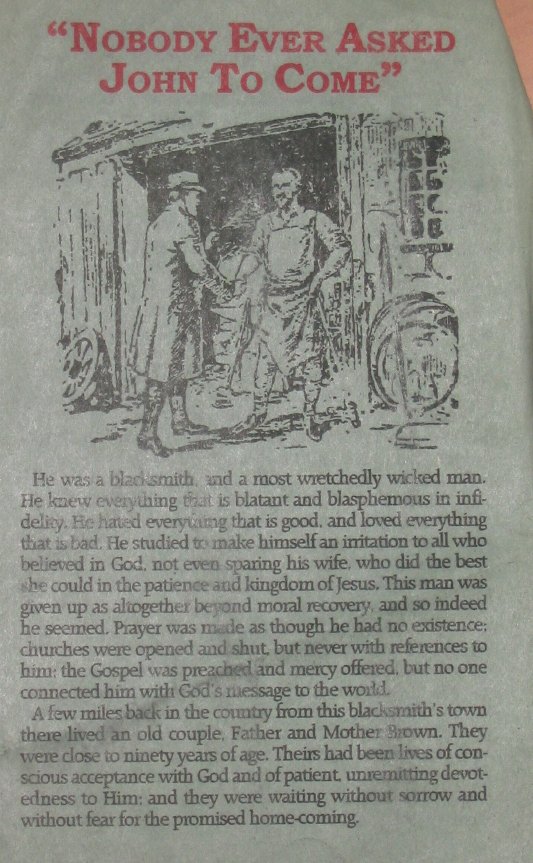
Nobody Every Asked John to Come

He was a blacksmith, and a most wretchedly wicked man. He knew everything that is blatant and blasphemous in infidelity. He hated everything that is good, and loved everything that is bad. He studied to make himself an irritation to all who believed in God, not even sparing his wife, who did the best she could in the patience and kingdom of Jesus. This man was given up as altogether beyond moral recovery, and so indeed he seemed. Prayer was made as though he had no existence; churches were opened and shut, but never with references to him; the Gospel was preached and mercy offered, but no one connected him with God’s message to the world.

Hello, Christian Stereotype Number One. Look, even the most antireligious atheists I’ve ever known don’t generally go out of their way to annoy Christians—though to some, just being openly godless is enough of an affront. Although I will say the bit about churches shutting him out is extremely plausible.

A few miles back in the country from this blacksmith’s town there lived an old couple, Father and Mother Brown. They were close to ninety years of age. Theirs had been lives of conscious acceptance with God and of patient, unremitting devotedness to Him; and they were waiting without sorrow and without fear for the promised home-coming.

And here’s Christian Stereotype Number Two. Aren’t they adorable? All together now: awwww. Note how black-and-white the world is in these tracts: Christians are totally faultless, non-Christians are complete monsters.

Anyway, one morning Father Brown wakes up all agitated and goes into town. His first stop is John’s blacksmith shop, to tell him about a dream he had.

Together they went into the shop, and when seated, the old man said: “John, I had a dream last night, and I’ve come to tell you about it. I dreamed that the hour I have thought about so much and tried to keep ready for so long was come. It was my time to die. And it was just like I thought it was going to be, for it was just as the Lord promised it should be. I wasn’t the least bit afraid. How could I be? My room was full of angels, and they all spoke to me, and I loved them and know[sic] they loved me. Then some of them stooped and slipped their arms under me, and away we went. Beyond the clouds we mounted thru[sic] the starry skies. Oh, how they sang! I never heard anything like it in my life. On we swept, and on till one of them said, ’Look yonder now; there is Heaven.’

Heaven, as seen in Father Brown’s dream, is pretty kickass. There’s music and singing and happiness and everybody welcomes him. He sees all his children. After a time, his wife is also brought in. There’s gladness and rejoicing until he notices that John the blacksmith isn’t in Heaven. So Brown goes and asks Jesus where John is.

“And O John, that you could have seen how sorry He was when He told me that you hadn’t come. And He wept, as I suppose He often did when He was down here, and told me, ‘Nobody ever asked John to come.’ Oh, I fell at His feet. I bathed them with my tears. I laid my cheeks upon them and cried: ‘Blessed Lord! just let me out of here an hour, and I’ll go and ask him to come. I’ll give him an invitation.’ And right then and there I woke up. It was beginning to get light in the east, and I was so glad I was alive, so I could come and ask you to go to Heaven: and now here I am and I have told you my dream, and want you to go.”

Father Brown trots out some more Bible verses while John listens unable to move, as if in a trance. Then he leaves; John tries to get on with work, but none of his equipment is working right.

“God, be merciful to me a sinner!” he began to sob at last, and leaving the shop, he went home. He told his wife of Father Brown’s visit. “Blessed be God!” she said. “We will send the horse and buggy and have him come back.” “Yes,” he added, “for I mean to accept the invitation, and I want him to pray to God to keep me true and steadfast to the end.”

And the tract concludes with a few more choice Bible verses.

Now, I don’t know about you, but if one of my Christian friends came to me babbling about some dream of Heaven and begging me to convert? I’d tell them to fuck right off, though maybe not in those exact words. Fortunately none of them have ever tried, although I have been witnessed to by strangers on a couple of occasions, in video arcades and at bus stops. Not to mention having read the Bible several times in two languages, and reading all flavours of Good News on the Web. Yes, I’ve heard of Jesus. Now leave me alone.

These missionary types seem to believe faith is bubbling just beneath the surface, waiting for the right Bible verse to erupt. And I’m sure they imagine they’ll be the one to do it, because their spiel is unique and special and not at all recycled pablum that their target has heard a thousand times before. They think they’re being helpful when really, they’re obnoxious pests. Because these naive missionaries, so hopped up on spreading the good word, have no fucking clue how other people think and feel.

This tract is actually the least offensive of the lot, and falls more in the “extremely irritating” category. There’s no mention of hell at all, which is pretty unusual for old-time missionary literature. And, fun question: it’s a good thing that everybody important to Father Brown was there in Heaven. What would have happened if he had really died before inviting John? Would he still have missed him? Ah, but then his happiness wouldn’t have been perfect. Maybe what happens is that you forget about all the people you knew, and all the ones you didn’t, who ended up in The Other Place. That way you don’t have to worry about empathising with eternally tormented souls.

Speaking of which…

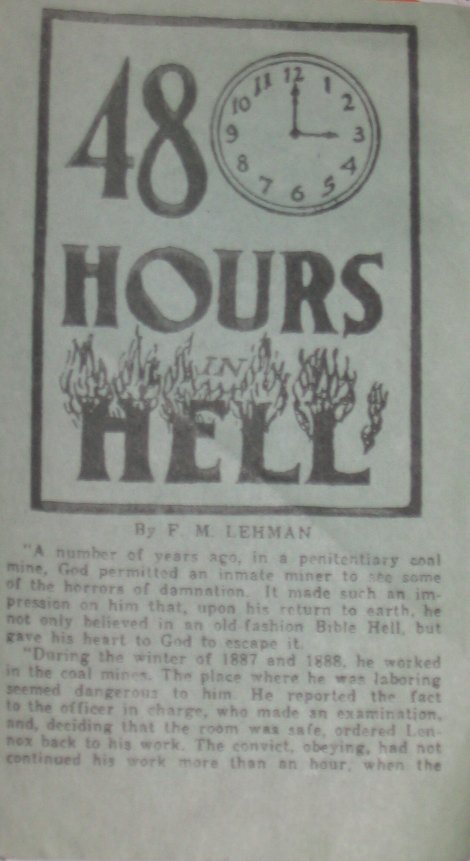
48 Hours In Hell

Hey, does anybody else have Love & Rockets’ fourth (self-titled) album? One song on it, Bound For Hell, relates a dream of a hell-bound train filled with damned souls, and concludes with the narrator waking up horrified by what awaits him if he doesn’t fly straight. It looks like it was actually adapted from an old folk song (which also inspired a pretty freaky short story by Robert Bloch), but it’s exactly what you’d get if you put one of these hellfire tracts to music.

A number of years ago, in a penitentiary coal mine, God permitted an inmate miner to see some of the horrors of damnation. It made such an impression on him that, upon his return to earth, he not only believed in an old-fashion[sic] Bible Hell, but gave his heart to God to escape it.

This miner accidentally gets buried for several hours and, when found, seems quite dead. Burial preparations are made but when the “corpse” is carried to the coffin, one of the inmates trips over a cuspidor (i.e.: a spittoon. Yes, I had to look that up). The only-mostly-dead inmate hits his head on the floor, and miraculously wakes up.

The story (except for the concluding paragraphs) is narrated by a reporter—named “Mr. Reynolds” only at the very end—who somehow learns of these unusual events and gets the miner’s story, which he relates verbatim. (And maybe it’s just me, but it feels like an old-fashioned story structure. The only evidence I have for this is that H.G. Wells’ The Time Machine was written is that way.)

The miner was working down in the mine; suddenly there’s darkness, then an impression of “a great iron door” through which the miner passes. Then:

From some cause unknown to myself, I started to move away from the doorway, and had traveled some distance, when I came to the banks of a broad river. It was not dark, neither was it light. There was about as much light as on a bright star-lit night. I had not remained on the banks of this river very long until I could hear the sound of oars in the water, and soon a person in a boat rowed up to where I was standing. I was speechless. He looked at me for a moment and then said that he had come for me, and told me to get into the boat and row across to the other side.

(Nice Greek Underworld motif there. Except I believe Charon stands up in his boat and poles across the Acheron.)

On the opposite shore, the miner sees two roads: one broad and well-travelled, one narrow. He of course takes the well-travelled road, and meets a demon.

He resembled a man somewhat, but was much larger than any human being I ever saw. He must have been at least ten feet tall. He had great wings on his back. He was black as the coal I had been digging, and in a perfectly nude condition. He had a spear in his hand, the handle of which must have been fully fifteen feet in length. His eyes shone like balls of fire. His teeth, white as pearl, seemed fully an inch long. His nose, if you will call it a nose, was very large, broad and flat. His hair was very coarse, heavy and long.

The African-American demon guides him to another, similar, demon who announces Thou art in hell. Then—just to add insult to injury—the miner is granted a glimpse of Heaven before being cast into the Lake of Fire. There are flowers and singing and walls of jasper and angels and all sorts of lovely stuff. He sees his mother there, “who died a few years ago of a broken heart because of my wickedness.” He is then led through another door:

Just before me I could see, as far as eye could reach, that literal lake of fire and brimstone. Huge billows of fire would roll over each other, and great waves of fiery flame would dash against each other and leap high into the air like the waves of the sea during a violent storm. On the crest of the waves I could see human beings rise, but soon to be carried down again to the lowest depths of this awful lake of fire. When borne on the crests of these awful billows, for a time, their curses against a just God would be appalling, and their pitiful cries for water would be heart-rending. This vast region of fire echoed and re-echoed with the wails of those lost spirits.

Presently I turned my eyes to the door through which I had a few moments before entered, and I read these awful words This is thy doom. Eternity never ends.

Meh. It’s no Lasciate ogne speranza, voi ch’intrate. Sidenote: until I reread this tract recently, I’d remembered the words on the door as “Eternity begins now.” Which I think would have been much cooler.

Just as the miner is falling into the lake, he wakes up, and vows never to enter Hell again. He’s seen both his reward and his punishment, and he’s giving his heart to God.

The miner was permitted to see Heaven and Hell just as he described them to Mr. Reynolds, which tallies wonderfully with the Bible description of each place—the home of the saints—the place of the damned.

Well, first of all, no it doesn’t. There’s no boatman or bat-winged demons mentioned in the Bible. Dante’s Inferno, yes, but not the Bible. And while the New Jerusalem (as mentioned in the Book of Revelation) does indeed have a river and foundations of jasper, there’s no mention of flowers or beautiful fragrances. (Though maybe that’s in the Paradiso, it’s been ages since I’ve read it.) Second, even ignoring these embellishments, near-death experiences are culture-specific, so of course this miner (if he weren’t fictional) would see images from the Christian afterlife, instead of, say, the Eater of Hearts.

Enough nitpicks. The real horror here is that, first, the writer is totally getting off on describing the screams and the torments, which he believes are literally real. So what am I, the reader, supposed to get out of it? Fear of eternal punishment? I admit, if I saw the Lake of Fire (outside of some near-death hallucination), I’m sure I’d scream and cry and soil myself just as if I’d rolled into Treblinka or Auschwitz. I’d probably beg and plead for mercy. But I wouldn’t wholeheartedly convert just because God is big and strong and can make me fry for a long time, or promises flowers and harps and all the best X-Box games if I behave. And when my pleas are ignored, you better believe I’d be cursing God too. Because only an infinitely cruel tyrant would sentence even one person, no matter how evil and depraved, to an eternity of torture. And only a morally deficient coward would call that justice or the act of a loving being, and get others to worship this monster. God created Hell, and decided the rules for who ends up there, so he’s ultimately responsible for the suffering in his fiery basement. But smug self-righteous Christians either don’t see that or don’t care; as long as they get to frolic with the angels when they die then everything’s peachy.

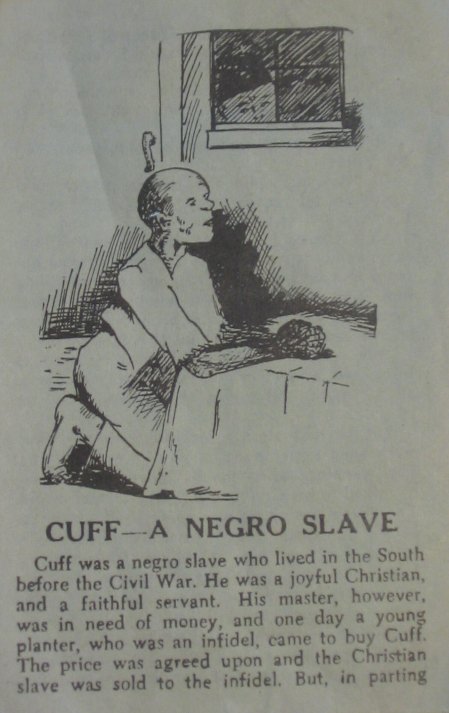
Cuff — A Negro Slave

Cuff - A Negro Slave

Cuff was a negro slave who lived in the South before the Civil War. He was a joyful Christian, and a faithful servant.

Times are hard, and his master sells him to an “infidel,” who vows to stop Cuff from praying. But Cuff says:

O Massa, I loves to pray to Jesus, and when I pray I loves you and Missus all the more, and can work all the harder for you.

Massa doesn’t like it, Cuff keeps praying and gets whipped, but still goes on working.

Meantime, God was working on the Master. He saw his wickedness and cruelty to that poor soul, whose only fault had been his fidelity, and conviction seized upon him. By night he was in great distress of mind.

Massa feels so bad that he thinks he’s dying. But he doesn’t want a doctor, he wants someone to pray for him because he’s afraid of going to hell. So they send for Cuff.

The master, groaning, said, “O Cuff, can you pray for me?”

“Yes, bless de Lord, Massa, I’se been prayin’ for you all night,” and then dropped on his knees, and, like Jacob of old, wrestled in prayer; and before the breaking of day witnessed the conversion of both master and mistress. Master and slave embraced, race differences and past cruelty were swept away by the love of God, and tears of joy were mingled.

Cuff is set free and the master goes out to preach the Gospel. The reader is asked not to resist our loving Saviour any longer. The End.

There. Wasn’t that heartwarming? Of course the characters are the same one-dimensional stereotypes we’ve seen before; the Christian is a meek and passive doormat who does nothing but obey his earthly and divine masters, while the “infidel” is an inhumanly cruel bastard who hates Christianity for no reason. And then, just as arbitrarily, repents of his misdeeds. Which begs the question of why God couldn’t have been “working on” the Master before he tortured that poor slave—and also begs the other question of where the Master’s free will was in all of this.

Story logic aside, there’s an extra dimension to this tract, which easily makes it the most disturbing in my collection, and that is its glorification of slavery: Cuff’s humble and helpless condition is held up as the ideal for Christians, something to inspire them. His sufferings aren’t depicted to show the inherent injustice of slavery, how wrong it is for one human being to own another and have complete power over them. No, we’re supposed to admire Cuff for his unconditional obedience, sweet childlike faith, and (most of all) contentment with his lot in life. This, along with his mangled English, makes Cuff very much a stereotypical Uncle Tom character. Images and stories like Cuff’s—along with many Bible-based arguments—served to justify or excuse slavery and, later, the Jim Crow laws. This attitude persists even today, though you’ll only see it displayed openly in some hardcore bigots such as Promise Keepers.

The Day I Kept Volleying To Myself While Wearing a Feather Boa

…while accompanied by a woman dressed like a volleyball and a man wearing an itty-bitty speedo, with volleyballs painted on his ass cheeks.

Yes kids, it was Pride Day, and I walked with the VGVA posse. Since most of them were in Montreal for the Gay Games, it was a pretty small production this year, just a small truck with rainbow balloons and streams and music… nothing too special.

…while accompanied by a woman dressed like a volleyball and a man wearing an itty-bitty speedo, with volleyballs painted on his ass cheeks.

Yes kids, it was Pride Day, and I walked with the VGVA posse. Since most of them were in Montreal for the Gay Games, it was a pretty small production this year, just a small truck with rainbow balloons and streams and music… nothing too special. We handed out little rubber bracelets with the VGVA Website on them, sprayed people with water, and I practiced my setting for the enjoyment of the people. Well, and also my own enjoyment.

Incidentally, a feather boa isn’t the best accessory to play volleyball in, especially when it’s, like, a hundred degrees. I was surprised at how warm those things are, at least around the neck. Gads, I don’t know how drag queens do it, I really don’t, with the dresses and the wigs and the accessories. How did they even keep their makeup in place, in yesterday’s heat? Laura (the human volleyball) had a bit of mascara on, and by the end of the parade it was running all over the place. But I had lots of fun. It was a nice change to be in the parade instead of watching it. On the one hand, I could only check out the floats just in front and behind us. On the other, I got to dance and play in front of all the people crowded along Denman and Pacific. Though I wasn’t exactly the centre of attention (see above, re: speedo, volleyball ass cheeks) it was a powerful experience to a formerly very shy, now not-quite-so-shy, guy such as myself.

Apocalypse Then And Now

Exhibit A: an ancient, horribly low-budget film about the Rapture.

Exhibit B: They’re making a video game based on the Left Behind movies.

Exhibit A: an ancient, horribly low-budget film about the Rapture.

I guess what’s really shocking isn’t the bargain-basement production values, or the dull pacing, it’s the cheap and mundane fears being peddled. Maids going missing? Milk not delivered on time? A lot of open graves? All right, they get into rivers of blood and so on near the end, and the bit about vanishing doctors and train engineers is a bit worrying… but, you know, that could be avoided by forbidding born-again Christians from performing critical tasks since they could be raptured any time. “Do not operate heavy machinery while saved.” Which, by the way, raises the question: assuming for the moment it’s real, how many people will actually vanish during the Rapture? In other words, who are the Real Christians™? Well, even the self-identified born-again can’t agree on that one; but the requirements must be pretty harsh, so the number of raptured people is probably small. I’ll just guess offhand they’re mostly—though not exclusively—in the Bible Belt, rural, on average less educated (not many heart surgeons, then). And they’d tend to cluster, so whole communities would be carried off together. Here in Canada I guess we’d lose… Abbotsford? Meh, I can live with that.

The film continues with more tales of Sugarcandy Mountain, about how wonderful it’ll be to fly through the air away from from the woes of this world, heartache and war and icky unbelievers. But the way they blame Christians for the sufferings of unbelievers who are doomed to live through the Tribulation (and could have been reached if only you the viewer had witnessed just a little bit harder) is frankly sick. Just what fundie nuts need: in addition to fear of God and fear of the Devil, now they’ve got to deal with the guilt that rightfully belongs to their so-called loving deity as he maims and smites.

Digging around I found another film by this guy, helpfully explaining why we need Christ’s loving dynamite to turn our hearts to manure, which will then undergo nuclear fusion. Or something. I may have tuned out a couple of times.

Exhibit B: They’re making a video game based on the Left Behind movies.

I saw a few minutes of the first Left Behind movie years ago (the bit where every True Xian™ vanishes, leaving their clothes and possessions behind), then I changed the channel. What was the point? I’d read the Book of Revelation, I knew how the story was going to play out. Although I guess the Bible didn’t have some tragically hunky reporter witnessing the last days. (Well, sorta hunky. I used to think Kirk Cameron was soooo hot, back in the day. Now? Not so much.) But underneath the special effects, it’s just the same warmed-over crap. And now that crap becomes interactive. Wheee.

Honestly, who believes this can work as a conversion tool? What will people learn about Xianity, except that it involves fighting the United Nations and racking up points for saving souls? Or is it just aimed at paranoid fundies so they can live out their end-of-the-world fantasies?

The sad thing is, there are people who take this stuff very seriously. In 1941, the prophecies were “not far from fulfillment” (no doubt because of World War II). Sixty-five years later, some people are still insisting the Apocalypse is almost at hand. Fifty years from now, sadly, I’m sure there’ll be more wars and famines and plagues for fundies to get excited about. I wish I could be witty about this, but really it’s just depressing. Millenial fundies really get turned on by wars and calamities, because it’s clear they hate this world and want it gone. Other people’s sufferings are not real to these loons, just a sign that they’ll get their reward. It’s just monstrously selfish.

Exhibit C: George W. Bush himself and his creepy fundie crowd. I’ll just let that speak for itself.