Nature’s Mothers

Surinam Toads—spectacularly fugly critters native to northeastern South America—have a rather odd means of reproduction. After mating, the male presses the eggs onto the female’s back. The eggs stick to her skin, which begins to grow over them. A few months later they emerge as toadlets, having already hatched and passed through the tadpole stage. Check it out, it’s equal parts gross and cool.

Surinam Toads—spectacularly fugly critters native to northeastern South America—have a rather odd means of reproduction. After mating, the male presses the eggs onto the female’s back. The eggs stick to her skin, which begins to grow over them. A few months later they emerge as toadlets, having already hatched and passed through the tadpole stage. Check it out, it’s equal parts gross and cool.*

* Though let’s face it, the way my species does it isn’t any prettier, and probably a lot more painful.†

† And giving birth from your back isn’t even the weirdest example of parental care Nature’s got up her sleeve. For instance, I learned very young that seahorse males receive eggs from the females and incubate them in a special pouch. Which honestly raises the question of how you label the sexes: is it just a matter of gamete size? Or who’s fertilising what? Because if the female has an organ to deposit eggs in the male‘s pouch, then… who really wears the pants in the household?

(Digression: I’ve long thought that if seahorses ever had a pro-choice movement, it’d be headed by males.)

But my personal favourite has to be Caecilians: an order of amphibians spanning a couple hundred species that, like us but unlike all other amphibians, practice internal insemination. Three-quarters of them give birth to live young. And the mother feeds them herself—no, not with milk. And not with prey. With her own skin. Hey, don’t knock it: that stuff’s apparently chock full of nutrients, and allows the little darlings to grow to 10 times their birth weight in a week.‡

‡ I wonder if that’s how mammals evolved? Did our ancestors start out nibbling their mother’s skin, move on to lapping up her sweat as soon as she got sweat glands—better for the mother, because skin was getting expensive, what with fur and all the various bits needed for warm-bloodedness—and kept enjoying the milk from modified sweat glands?

(Surinam Toad video link via Pharyngula. Proper use of daggers and double-daggers courtesy of RomanBoldOblique and Wikipedia.)

“This is my timey-wimey detector. Goes ‘ding’ when there’s stuff.”

So this weekend I saw Blink, an episode from the new Doctor Who series.

And wow, was that the creepiest hour of my life. “Don’t blink. Don’t even blink. Blink and you’re dead.”

So this weekend I saw Blink, an episode from the new Doctor Who series.

And wow, was that the creepiest hour of my life. “Don’t blink. Don’t even blink. Blink and you’re dead.” Now I’m starting to see what the town council had against that living statue in Hot Fuzz, because yes, there’s something fundamentally wrong with creatures that only move when you’re not looking at them. And horribly scary, because your only defense is to keep looking at them. Could you focus on a Weeping Angel continually, not looking away, not even blinking, even if your life depended on it? Because I’m pretty sure I couldn’t. I tried just blinking one eye at a time, but that didn’t work for long.

Add a spookily gorgeous abandoned house to really punch up the horror feel, just a dash of whimsy here and there, an ending montage especially designed to ramp the paranoia up to 11, and you’ve got yourself a show that’ll send delicious chills up your spine again and again.

(Even some of the more lighthearted moments were intensely disturbing, like the Doctor’s “conversation” with Sally through a DVD, reading from a script which hadn’t been written yet from Sally’s point of view. Hah. I guess time is a big ball of wibbly-wobbly timey-wimey stuff. Although it’s interesting to note there were no actual time paradoxes in this storyline. All the events fit together nicely, if not… linearly. Except I’m not sure how the message under the wallpaper fit in.)

Arthur C. Clarke: 1917–2008

Well, damn.

I guess part of me thought he’d live forever, or at least long enough to see all the marvels he imagined or predicted. Hell, he saw geostationary satellites and global telecommunications become reality, why not space elevators or Martian colonies or deep-space travel as well?

Well, damn.

I guess part of me thought he’d live forever, or at least long enough to see all the marvels he imagined or predicted. Hell, he saw geostationary satellites and global telecommunications become reality, why not space elevators or Martian colonies or deep-space travel as well?

As a young nerd I read a number of his books: Dolphin Island was first, I think, way back in high school English class, though I haven’t picked it up since. There were also some of the classics, like 2001, Childhood’s End, The Sands of Mars, Rendezvous With Rama (never got into the sequels), The Fountains of Paradise. I loved them all, but my favourite was and still is The Songs of Distant Earth. Almost every page is gold, from the arrival of the Magellans to Thalassa to Moses Kaldor’s discussion of God (a theme Clarke picks up every now and then in his fiction), the conflicts, the heartbreaks, the dramas big and small, as well as the scorps’ evolution to semi-sentience. Like much of his work before and since, Songs shows us a very optimistic future. It’s a future where humanity has grown up, and mostly left aggression and bigotry behind; where we can find peace without sacrificing progress, and without losing our essential nature. A future where race, religion, gender and sexuality are just not that big a deal, and the boundaries of love and family are wider and more flexible.

Lieutenant Horton was an amusing companion, but Loren was glad to get rid of him as soon as the electrofusion currents had welded his broken bones. As Loren discovered in somewhat wearisome detail, the young engineer had fallen in with a gang of hairy hunks whose second main interest in life appeared to be riding microjet surfboards up vertical waves. Horton had found, the hard way, that it was even more dangerous than it looked.

“I’m quite surprised,” Loren had interjected at one point in a rather seamy narrative. “I’d have sworn you were ninety percent hetero.”

“Ninety-two, according to my profile,” Horton said cheerfully. “But I like to check my calibration from time to time.”

The lieutenant was only half joking. Somewhere he had heard that hundred percenters were so rare that they were classed as pathological.

Heh. Yes, it’s completely gratuitous, but Clarke pulls it off, and I can’t tell you what that kind of writing meant to my still-closeted teen self. I like to think it eventually helped me come out to myself, or at least made the way smoother by defusing any internalised homophobia I may have had.

More recently I bought his Collected Stories, a massive sampling of his short stories from 1937 to 1997. Though it’s hard to pick a favourite amongst all these gems, I’m very fond of the “White Hart” stories. Written in the 40’s and 50’s, these take place in the (probably partly real) London pub “White Hart,” a hangout of writers and engineering geeks. These loosely connected tales of university life and improbable inventions, full of dry, low-key British humour, remind me of P.G. Wodehouse’s stories—though with nutty professors and eccentric inventors instead of useless upper-class twits.

I also have to give a special nod to The Wire Continuum, the last one in the collection. Co-written with Stephen Baxter (another fave author of mine), this is a sequel to the very first story in the book, entitled Travel by Wire! A cute but unremarkable story of matter transmission through power lines is re-explored sixty years later as these two stupendously smart and talented minds play at finding applications to this technology. We’re treated to surgical teleportation, faster-than-light communication, instantaneous extrasolar travel and finally, the direct linking of minds leading to an evolutionary quantum leap for humankind. Some of these ideas are further fleshed out in The Light of Other Days, another Baxter/Clarke collaboration.

Finally, there’s an essay of his I reread regularly: “Arthur C. Clarke’s ‘Credo'”, appearing in the September/October 2001 issue of Skeptical Inquirer (one of several specials they did on science and religion). I found it a bit rambling and unfocussed, which I guess is understandable when you’re trying to talk about God and what others have said about God. But the grand vision, gentle humour and warm optimism are pure Clarke.

I began this essay by saying that men have debated the problems of existence for thousands of years—and that is precisely why I am skeptical about most of the answers. One of the great lessons of modern science is that millennia are only moments. It is not likely that ultimate questions will be settled in such short periods of time, or that we will really know much about the universe while we are still crawling around in the playpen of the Solar System.

He concludes by quoting form his earlier book Profiles of the Future: An Inquiry into the Limits of the Possible. I get chills every time I read this passage.

Our galaxy is now in the brief springtime of its life—a springtime made glorious by such brilliant blue-white stars as Vega and Sirius, and, on a more humble scale, our own Sun. Not until all these have flamed through their incandescent youth, in a few fleeting billions of years, will the real history of the universe begin.

It will be a history illuminated only by the reds and infrareds of dully glowing stars that would be almost invisible to our eyes; yet the somber hues of that all-but-eternal universe may be full of color and beauty to whatever strange beings have adapted to it. They will know that before them lie, not the millions of years in which we measure eras of geology, nor the billions of years which span the past lives of the stars, but years to be counted literally in trillions.

They will have time enough, in those endless aeons, to attempt all things, and to gather all knowledge. They will be like gods, because no gods imagined by our minds have ever possessed the powers they will command. But for all that, they may envy us, basking in the bright afterglow of Creation; for we knew the universe when it was young.


Fog, Fish and Old-Time Photos

This has been a pretty interesting weekend. On Leap Friday I almost went skiing. A couple of friends and I had planned it in advance, but the weather turned out to be too warm. It was raining in the city, and even on top of Seymour it wasn’t much more than heavy, wet snow. But that was nothing compared to the killer fog. Seriously, the drive up (and back down) was harrowing; without those little reflector thingies in the middle of the road, I’m sure we would have either crashed or plunged to our deaths a dozen times.

This has been a pretty interesting weekend. On Leap Friday I almost went skiing. A couple of friends and I had planned it in advance, but the weather turned out to be too warm. It was raining in the city, and even on top of Seymour it wasn’t much more than heavy, wet snow. But that was nothing compared to the killer fog. Seriously, the drive up (and back down) was harrowing; without those little reflector thingies in the middle of the road, I’m sure we would have either crashed or plunged to our deaths a dozen times. And yes, it was very pretty, but there ain’t no way you can ski in that.

So we just went back to hang out at their place and watch anime.

Saturday was my first Taiji class in over a month. What with one thing and another, either the class was canceled or I couldn’t make it. It felt good to practice again and (bonus!) work on the staff form.

Sunday? Five hours of volleyball. And a special challenge as I got to play Setter for the first time in… well, ever. I wasn’t very good at it, sad to say, as I kept drifting back to the Middle position. But after a few games I got a little better; and I also got newfound respect for that position. I knew it was the hardest to play, but damn.

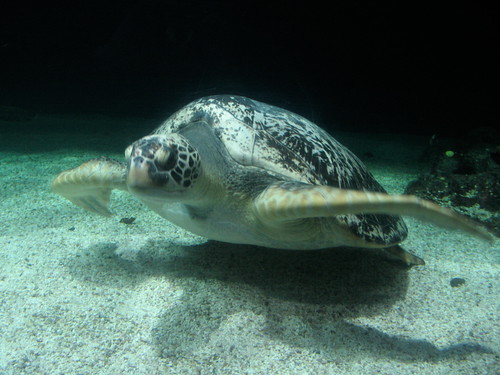
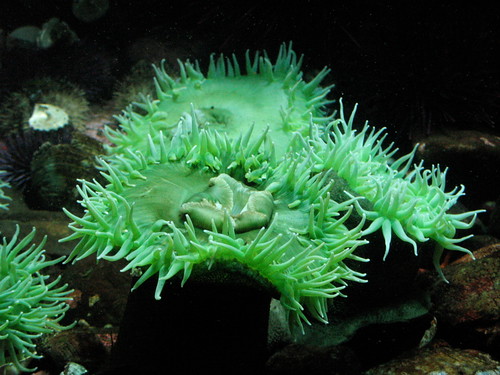
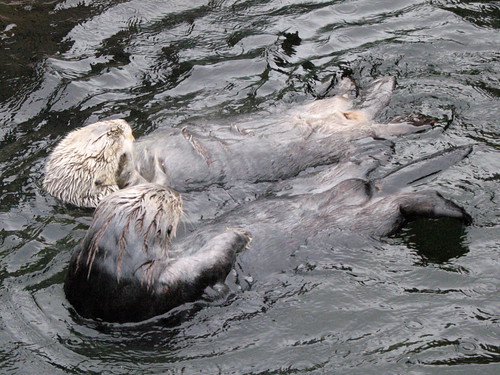
Monday, I had off. And I had a choice to make: should I sleep in, then veg around all day? It was tempting, especially since I’d recently bought the Little Britain DVD set. But no, I was going to enrich my mind. So I took the train as usual, and spent the rest of the morning at the Aquarium. I hadn’t been in ages, and it was great to get reacquainted with the froggies and the fishies and the anemones and the alligator and the sea otters (OMG SO CUTE!!!) and the belugas and the dolphins.

First you were like, whoa! And then we were like, WHOA!

Anemones

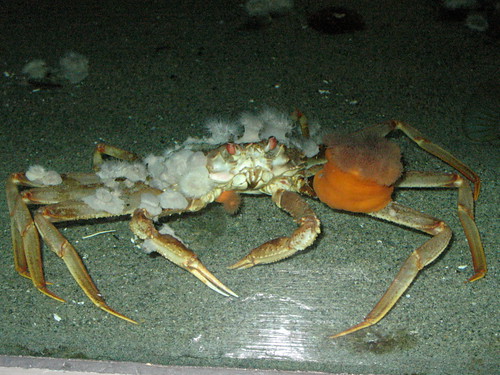
Clothed Crab

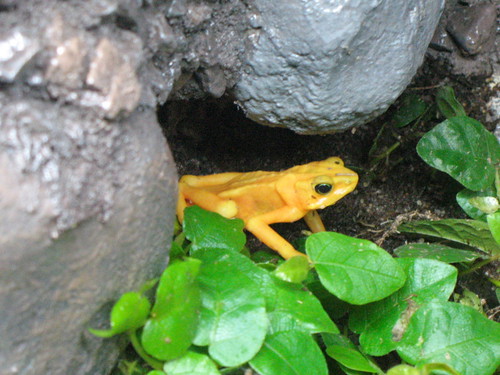
Panamanian Golden Frog

Sea Otters

Finale

The bad weather put the kibosh to my plan to walk along the seawall, so I came back downtown and visited the Art Gallery. Did you know, the place isn’t just for political rallies? That they use it to actually display art? It’s true! Seriously, though, this first ever visit to the gallery was wonderful. I especially enjoyed TruthBeauty, an exhibition on the Pictorialist movement. I think what captivated me was the Pictorialists’ exploration of this brand-new medium, experimenting with mood and composition—just as I am myself doing, though part of me feels like a rank amateur compared to these past masters.

No, don’t mind me. This is just something that’s been percolating for a while; I’m looking for… inspiration, I guess, different directions, in my photography, but I don’t know where to look. Maybe the Pictorialists will give me a clue. In the meantime, I’ll just keep my eyes open and my camera ready.