Some Darwin Quotes

I’m still partway through The Descent of Man (specifically, the 1882 edition, available online.) It’s slow reading because I want to be sure to absorb the science… and the occasional bon mots.

I’m still partway through The Descent of Man (specifically, the 1882 edition, available online.) It’s slow reading because I want to be sure to absorb the science… and the occasional bon mot.

It has often and confidently been asserted, that man’s origin can never be known: but ignorance more frequently begets confidence than does knowledge: it is those who know little, and not those who know much, who so positively assert that this or that problem will never be solved by science.

Consequently we ought frankly to admit their community of descent: to take any other view, is to admit that our own structure, and that of all the animals around us, is a mere snare laid to entrap our judgment. […] It is only our natural prejudice, and that arrogance which made our forefathers declare that they were descended from demi-gods, which leads us to demur to this conclusion. But the time will before long come, when it will be thought wonderful that naturalists, who were well acquainted with the comparative structure and development of man, and other mammals, should have believed that each was the work of a separate act of creation.

He who rejects with scorn the belief that the shape of his own canines, and their occasional great development in other men, are due to our early forefathers having been provided with these formidable weapons, will probably reveal, by sneering, the line of his descent. For though he no longer intends, nor has the power, to use these teeth as weapons, he will unconsciously retract his “snarling muscles” (thus named by Sir C. Bell),46 so as to expose them ready for action, like a dog prepared to fight.

The formation of different languages and of distinct species, and the proofs that both have been developed through a gradual process, are curiously parallel. But we can trace the formation of many words further back than that of species, for we can perceive how they actually arose from the imitation of various sounds. We find in distinct languages striking homologies due to community of descent, and analogies due to a similar process of formation. The manner in which certain letters or sounds change when others change is very like correlated growth. We have in both cases the reduplication of parts, the effects of long-continued use, and so forth. The frequent presence of rudiments, both in languages and in species, is still more remarkable. The letter m in the word am, means I; so that in the expression I am, a superfluous and useless rudiment has been retained. In the spelling also of words, letters often remain as the rudiments of ancient forms of pronunciation. Languages, like organic beings, can be classed in groups under groups; and they can be classed either naturally according to descent, or artificially by other characters. Dominant languages and dialects spread widely, and lead to the gradual extinction of other tongues. A language, like a species, when once extinct, never, as Sir C. Lyell remarks, reappears. The same language never has two birth-places. Distinct languages may be crossed or blended together.

I saw the lunar eclipse

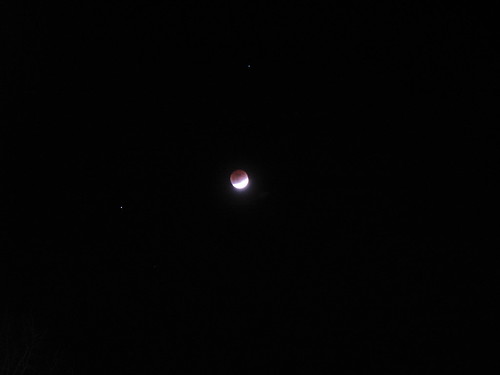
… and it wasn’t what I expected. Then again, I didn’t really know what to expect, since I’d never seen a lunar eclipse and wasn’t too clear on the actual mechanics. So the dark red moon, covered by a fuzzy circular shadow, took me a bit by surprise.

… and it wasn’t what I expected. Then again, I didn’t really know what to expect, since I’d never seen a lunar eclipse before and wasn’t too clear on the actual mechanics. So the dark red moon, covered by a fuzzy circular shadow, took me a bit by surprise. I was like, “Whoah! Did the Apocalypse start already?… oh, right, the eclipse. Cool!”

I was lucky. The sky was clear (a miracle for Vancouver at this time of year!) and I had to work late, which means I saw the bloody eclipse on the way home. Otherwise, I hate to say it probably would have slipped my mind. I got home a little late (around 8PM, the moon was just coming out of totality), but that didn’t stop me from grabbing my tripod and looking for a relatively dark spot. You can see Saturn to the left, and Regulus above.

Lunar Eclipse

Happy Darwin Day!

To celebrate Darwin Day, I’ve decided to start reading The Descent of Man. I’ve already got The Origin of Species and The Voyage of the Beagle under my belt, and I’ve been meaning to read Descent for a long time.

Which reminds me. At that creation/evolution debate I went to a while ago a creationist audience member brought up Darwin’s alleged racism, quoting from Descent of Man:

To celebrate Darwin Day, I’ve decided to start reading The Descent of Man. I’ve already got The Origin of Species and The Voyage of the Beagle under my belt, and I’ve been meaning to read Descent for a long time.

Which reminds me. At that creation/evolution debate I went to a while ago a creationist audience member brought up Darwin’s alleged racism, quoting from Descent of Man:

At some future period, not very distant as measured by centuries, the civilized races of man will almost certainly exterminate, and replace, the savage races throughout the world.

Seen in context, it’s clear Darwin is really making a point about the lack of intermediate forms between humans and apes. As for the exterminating savage races bit? Most white people thought in terms of a hierarchy of races, with Western Europeans at the top, and either Blacks or Australian Aborigines at the bottom. And a lot of people believed then that Blacks and Native Americans were headed for extinction. Their cultures were being ravaged, their lands were taken, the people themselves were sold into slavery or rounded up into reservations… many Whites believed it was only a matter of time. They weren’t necessarily happy about it, mind you, but they honestly thought it was inevitable.

From his writings in Voyage of the Beagle I found Darwin very open-minded and respectful for a Victorian gentleman who’d never left England before. I have a hard time imagining a racist writing something like this:

(November 15, 1835)

The common people, when working, keep the upper part of their bodies quite naked; and it is then that the Tahitians are seen to advantage. They are very tall, broad-shouldered, athletic, and well-proportioned. It has been remarked, that it requires little habit to make a dark skin more pleasing and natural to the eye of an European than his own colour. A white man bathing by the side of a Tahitian, was like a plant bleached by the gardener’s art compared with a fine dark green one growing vigorously in the open fields.

Creationists (and others) may be interested to know that Darwin was passionately anti-slavery—still a hot issue at the time. Great Britain had only abolished slavery in 1832, the first Western nation to do so (okay, France abolished it in 1794, but reinstated it again in 1802. It was abolished for the last time in 1848).

April 14, 1832. Near Rio de Janeiro.

While staying at this estate, I was very nearly being an eye-witness to one of those atrocious acts which can only take place in a slave country. Owing to a quarrel and a lawsuit, the owner was on the point of taking all the women and children from the male slaves, and selling them separately at the public auction at Rio. Interest, and not any feeling of compassion, prevented this act. Indeed, I do not believe the inhumanity of separating thirty families, who had lived together for many years, even occurred to the owner. Yet I will pledge myself, that in humanity and good feeling he was superior to the common run of men. It may be said there exists no limit to the blindness of interest and selfish habit. I may mention one very trifling anecdote, which at the time struck me more forcibly than any story of cruelty. I was crossing a ferry with a negro who was uncommonly stupid. In endeavouring to make him understand, I talked loud, and made signs, in doing which I passed my hand near his face. He, I suppose, thought I was in a passion, and was going to strike him; for instantly, with a frightened look and half-shut eyes, he dropped his hands. I shall never forget my feelings of surprise, disgust, and shame, at seeing a great powerful man afraid even to ward off a blow, directed, as he thought, at his face. This man had been trained to a degradation lower than the slavery of the most helpless animal.

So, yes. Somewhat prejudiced and chauvinistic, but also empathetic. And honest with himself and able to learn from his mistakes—as a good scientist should.

After Mauritius and South Africa, the Beagle swung by Brazil one last time before finally sailing home. Darwin shares his thoughts on the country:

On the 19th of August [1836] we finally left the shores of Brazil. I thank God, I shall never again visit a slave-country. To this day, if I hear a distant scream, it recalls with painful vividness my feelings, when passing a house near Pernambuco, I heard the most pitiable moans, and could not but suspect that some poor slave was being tortured, yet knew that I was as powerless as a child even to remonstrate. I suspected that these moans were from a tortured slave, for I was told that this was the case in another instance. Near Rio de Janeiro I lived opposite to an old lady, who kept screws to crush the fingers of her female slaves. I have stayed in a house where a young household mulatto, daily and hourly, was reviled, beaten, and persecuted enough to break the spirit of the lowest animal. I have seen a little boy, six or seven years old, struck thrice with a horse-whip (before I could interfere) on his naked head, for having handed me a glass of water not quite clean; I saw his father tremble at a mere glance from his master’s eye. These latter cruelties were witnessed by me in a Spanish colony, in which it has always been said that slaves are better treated than by the Portuguese, English, or other European nations. I have seen at Rio de Janeiro a powerful negro afraid to ward off a blow directed, as he thought, at his face. I was present when a kind-hearted man was on the point of separating forever the men, women, and little children of a large number of families who had long lived together. I will not even allude to the many heart-sickening atrocities which I authentically heard of;—nor would I have mentioned the above revolting details, had I not met with several people, so blinded by the constitutional gaiety of the negro as to speak of slavery as a tolerable evil. Such people have generally visited at the houses of the upper classes, where the domestic slaves are usually well treated, and they have not, like myself, lived amongst the lower classes. Such inquirers will ask slaves about their condition; they forget that the slave must indeed be dull who does not calculate on the chance of his answer reaching his master’s ears.

It is argued that self-interest will prevent excessive cruelty; as if self-interest protected our domestic animals, which are far less likely than degraded slaves to stir up the rage of their savage masters. It is an argument long since protested against with noble feeling, and strikingly exemplified, by the ever-illustrious Humboldt. It is often attempted to palliate slavery by comparing the state of slaves with our poorer countrymen: if the misery of our poor be caused not by the laws of nature, but by our institutions, great is our sin; but how this bears on slavery, I cannot see; as well might the use of the thumb-screw be defended in one land, by showing that men in another land suffered from some dreadful disease. Those who look tenderly at the slave owner, and with a cold heart at the slave, never seem to put themselves into the position of the latter;—what a cheerless prospect, with not even a hope of change! picture to yourself the chance, ever hanging over you, of your wife and your little children—those objects which nature urges even the slave to call his own—being torn from you and sold like beasts to the first bidder! And these deeds are done and palliated by men who profess to love their neighbours as themselves, who believe in God, and pray that His Will be done on earth! It makes one’s blood boil, yet heart tremble, to think that we Englishmen and our American descendants, with their boastful cry of liberty, have been and are so guilty; but it is a consolation to reflect, that we at least have made a greater sacrifice than ever made by any nation, to expiate our sin.

Happy 199th birthday, Charles.

Graphic Novel Review: Superman: Red Son

Look! Up in the sky! It’s a bird! It’s a plane! It’s Superman!

Superman: strange visitor from another world! Who can change the course of mighty rivers, bend steel in his bare hands…

And who, as the champion of the common worker, fights a never-ending battle for Stalin, socialism and the international expansion of the Warsaw Pact.

What if?

What if Superman’s ship did not land in Kansas? What if, instead of the heartland of America, it landed in the heartland of… the Ukraine? What if this Superman was raised to fight for truth, justice, and the Soviet way?

Look! Up in the sky! It’s a bird! It’s a plane! It’s Superman!

Superman: strange visitor from another world! Who can change the course of mighty rivers, bend steel in his bare hands…

And who, as the champion of the common worker, fights a never-ending battle for Stalin, socialism and the international expansion of the Warsaw Pact.

What if?

What if Superman’s ship did not land in Kansas? What if, instead of the heartland of America, it landed in the heartland of… the Ukraine? What if this Superman was raised to fight for truth, justice, and the Soviet way? This is the premise of Superman: Red Son, an 3-part DC Elseworlds miniseries published in 2003, and now conveniently collected in graphic novel form. I’d been hearing a lot of positive things about it for a while, but never got around to buying it until now.

In the interest of full disclosure, here’s another detail: Red Son was written by Mark Millar. Three years ago I wrote that he was the one who killed Northstar. Northstar got better, but I never forgot that first impression. A little later, I read the first storyline he did for The Authority (“The Nativity,” issues #13–16). You’ll have to wait for another post to get the full details, but let’s just say that I was not impressed. Bottom line, I came into this miniseries with a very low opinion of the author. So it’s possible this review is not 100% objective.

It’s the art that really grabbed me, not so much the story. Specifically, the colours. The first issue had a very limited and subdued palette: Supe’s costume is grey and dark red, with a black-and-red hammer-and-sickle where the bright yellow “S” should be. In fact, most of that issue is grey and red: the grey of clouds, concrete and black-and-white TV; the red of fire, blood and Soviet flags. I have to say, it made for a neat effect. The only breaks were the eerie green of Luthor’s lab, and Lois’ bright lavender dress upon her meeting with the Comrade of Steel. The second and third issues lightened up colour-wise, which I think is a shame since the story itself got darker and darker. But, there you go: different artists have different styles and I won’t quibble too much.

This being an Elseworlds there are plenty of references, both serious and sly, to established continuity. My favourite would be the full-page shot of Superman holding up the Daily Planet globe, a perfect call-back to the cover of Superman #1.
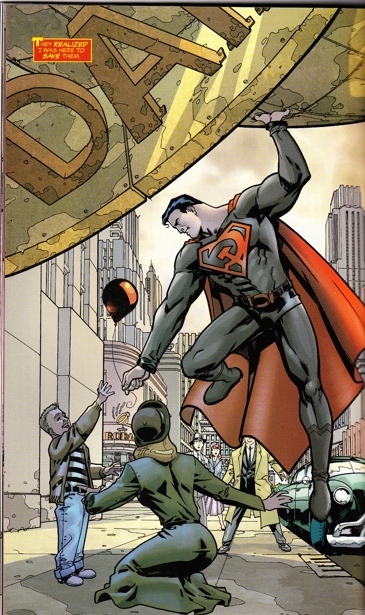
Superman: Red Son

Batman’s “Bat-signal” is a clever take on the original, being a deliberately rough graffiti to mar Supe’s pristine tyranny. Stalingrad in a bottle? Sure, why not. And I got a chuckle at the name of the famous American defector: Thaddeus Sivana (misspelled in this comic). Heh. At least we didn’t get Mr. Mind. On the downside, we didn’t get any insight into these alternate characters. Lois pines for Superman, despite only having seen him in the flesh for a moment. Lex Luthor is an astoundingly brilliant scientist, learning Urdu and playing six games of chess at once on his coffee breaks. Wonder Woman and Themyscira are… pretty unchanged. The Man of Steel himself is still an eternally compassionate boyscout, taking over the Soviet Union after Stalin’s death and turning it into an efficient totalitarian utopia because he wants to help people. Batman is still a ruthless vigilante, the only difference being that he’s head of a terrorist conspiracy against Superman’s rule.

But I didn’t see anything new or really insightful in these adaptations, even the twist of Lois being married to Lex. Frankly, I feel that kind of Elseworlds has been done to death, and Millar isn’t the first person to ask what would happen if Superman really tried to rule the world. (For one thing, he’d be wearing a Pope hat.)

All these nods and references (inspired or not) are perfectly acceptable in an alternate-universe story. But there was one line that made me go “Oh no he di-in’t!” Early in issue #1, Superman narrates:

I had made quite an impression in the fourteen weeks since I’d made my journey from the farm lands to Moscow.

Some still thought me a trick of the light or an urban myth, but each new day saw another super-feat or some death-defying rescue.

What’s so special about this line? It’s not original to Millar, nor does it come from the Superman œuvre as far as I know. It comes courtesy of Warren Ellis to describe John Cumberland, a.k.a. “The High,” the Wildstorm universe’s answer to Superman. From Stormwatch #48 (May 1997):

We call this man The High.

His first recorded activities were in the year 1938. He visited beatings upon corrupt landlords, nazi bunds, munitions tycoons; political acts. Quietly averted a few natural disasters. But there was never solid proof of his existence. He was dismissed as an urban myth.

And from Planetary #5 (September 1999):

John Cumberland, my God… There was brave man. Most people thought him a myth, or a trick of the light…

And Millar must know about Ellis’ work, since he took over The Authority from him. So… far be it from me to accuse anyone of plagiarism, but it definitely soured my reading of Red Son. Though if anyone can offer evidence that the “trick of the light” line is actually part of the Superman myth, I will stand corrected.

One other thing that turned me off is Millar’s lack of affection for the source material. Consider the opening quote of this post, part of a Communist propaganda film. That was actually taken pretty much word for word (except for the last part, obviously) from the awesome 1940’s Superman animated shorts and other classic sources. Which is cool. What’s less cool is Millar having Perry White commenting, “Aw, gimme a break. Who writes this stuff?” Look, we know Golden Age comics were cheesy and goofy as hell. That’s why we love them. There’s no need to make these little comments that I guess try for “ironic” but land on “obnoxious.” Also “hypocritical,” since he makes a living writing for the funny-books, though I guess it’s okay if he makes them all dark and bloody and junk.

And there were other parts that didn’t piss me off so much as… make me shake my head. Sloppy writing that should have been caught by an editor. When Superman leaves his own party, he finds the drunk and suicidal Pyotr two hundred miles away. But suddenly he hears people shouting for help in Moscow “two miles away”? Sivana’s name spelled with an extra “n”? The Moscow subway sign spelled in English but with a backward “S”? Then you’ve got Supe’s inner monologue, as he prevents Sputnik from crashing into Metropolis.

Sputnik Two weighed five thousand pounds. That mass multiplied by an acceleration factor of a hundred meters per second would have delivered a force powerful enough to level the entire city.

Okay, time for a refresher physics course: a hundred meters per second is a measure of speed, not acceleration. And energy (not force), is a function of mass multiplied by speed squared. Also, Sputnik-2 weighed a little over 500kg, or about 1,100 pounds. Seriously, Millar, two minutes with Google.

I won’t get into the various plot points that came out of nowhere, and especially not the ending, because that was just… weird, and came out of fucking left field. Krypton is future Earth? Meh, I dunno.

Bottom line: I did enjoy this graphic novel. True, it didn’t make me think much, and didn’t improve my opinion of Mark Millar. I don’t think it deserves the breathless praise everybody seems to be heaping on it, but hey: it was fun, occasionally clever, and had lots of nice visuals and cool fight scenes. Bring the popcorn, stay for the art.

File sorta not found

Well, the site itself works just fine, but it looks like there were a few issues left to deal with.

First, Wordpress wasn’t returning the right status code (404) when a requested page couldn’t be found. That was easily fixed. Returning the correct HTTP status is not too important for human browsers but is a huge deal for search engines because when you’re indexing the Web you need to know which pages actually exist.

Well, the site itself works just fine, but it looks like there were a few issues left to deal with.

First, WordPress wasn’t returning the right status code (404) when a requested page couldn’t be found. That was easily fixed. Returning the correct HTTP status is not too important for human browsers but is a huge deal for search engines because when you’re indexing the Web you need to know which pages actually exist.

The status code was only part of the problem, though. See, what WordPress does when you use custom URL rewrites (as I do) is, if the requested URL doesn’t map to an existing file, the request is redirected to a custom error page. The annoying side effect is that as far as the server is concerned, a file was delivered correctly and no error is logged. Which messes up my stats. Fortunately, there’s a solution: a WP plugin called Redirection. It handles 30* redirections as well as keeping a log of 404 errors. The former isn’t necessary for now, since only gallery & photo URI’s have changed—and I have to use .htaccess to handle those, since they’re outside WordPress, but the latter is a godsend. Not a perfect solution, since in a perfect world I shouldn’t even have to use workarounds, but I’m very happy with it.

Oh, and AWStats (the stats package I’m using) was counting each browsed page twice. Seems a gallery page (.php, which is counted as a page view and not just a hit) is called in the background to build the photo grid displayed in the sidebar. Fortunately AWStats allows you to ignore certain pages, and this won’t be a problem in the future.